Kamer Daron Acemoğlu is a Turkish-American economist of Armenian descent who has been at the Massachusetts Institute of Technology since 1993, where he is currently the Elizabeth and James Killian Professor of Economics. He was named an Institute Professor at MIT in 2019. His primary research fields include political economy, development economics, and labor economics. He received the John Bates Clark Medal in 2005, and the Nobel Memorial Prize in Economic Sciences in 2024.
From Wikipedia · CC BY-SA 4.0
28 books in our catalogue.
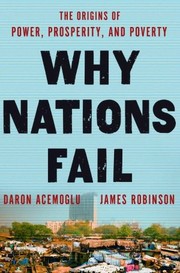
2012
529 pages
★ 3.75 · 36
Business & EconomicsPolitics & Society
Why are some nations rich and others poor, divided by wealth and poverty, health and sickness, food and famine? Is it culture, the weather, or geography that determines prosperity or poverty? As Why Nations Fail shows, none of these factors is either definitive or destiny. …
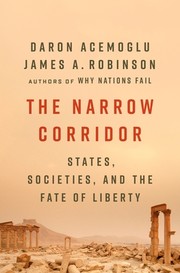
2019
576 pages
Politics & Society
xvii, 558 pages : 25 cm
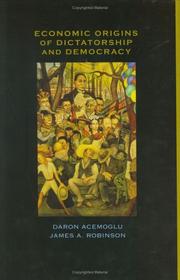
2005
434 pages
Business & EconomicsPolitics & Society
This book is the first to use modern social science methodology systematically to explain why some countries are democracies while others are not. Why does democracy sometimes persist and consolidate while other times it collapses? The treatment shows that whether or not a society becomes …
2014
810 pages
Business & Economics
2009
1008 pages
Business & Economics
Daron Acemoglu gives graduate students not only the tools to analyze growth & related macroeconomic problems, but also the broad perspective necessary to apply those tools to the big-picture questions of growth & divergence. He also introduces the economic & mathematical foundations of modern growth …
2015
808 pages
Business & Economics
2019
560 pages
Politics & Society
2010
46 pages
Business & Economics
We study a dynamic general equilibrium model where innovation takes the form of the introduction new goods, whose production requires skilled workers. Innovation is followed by a costly process of standardization, whereby these new goods are adapted to be produced using unskilled labor. Our framework …
2006
56 pages
Business & Economics
Inefficiencies in the bureaucratic organization of the state are often viewed as important factors in retarding economic development. Why certain societies choose or end up with such inefficient organizations has received very little attention, however. In this paper, we present a simple theory of the …
2014
500 pages
Business & Economics
2008
61 pages
Politics & Society
We investigate how nondemocratic regimes use the military and how this can lead to the emergence of military dictatorships. Nondemocratic regimes need the use of force in order to remain in power, but this creates a political moral hazard problem; a strong military may not …
2018
Business & Economics
2004
92 pages
Business & EconomicsHistory
"This paper develops the empirical and theoretical case that differences in economic institutions are the fundamental cause of differences in economic development. We first document the empirical importance of institutions by focusing on two 'quasi-natural experiments' in history, the division of Korea into two parts …
2009
46 pages
History
The French Revolution of 1789 had a momentous impact on neighboring countries. The French Revolutionary armies during the 1790s and later under Napoleon invaded and controlled large parts of Europe. Together with invasion came various radical institutional changes. French invasion removed the legal and economic …
2003
44 pages
Politics & Society
This paper develops a model where there is a trade-off between the enforcement of the property rights of different groups. An oligarchic society, where political power is in the hands of major producers, protects their property rights, but also tends to erect significant entry barriers, …
2010
24 pages
Business & EconomicsPhilosophy & Religion
I discuss the role of economic theory in empirical work in development economics with special emphasis on general equilibrium and political economy considerations. I argue that economic theory plays (should play) a central role in formulating models, estimates of which can be used for counterfactual …