The form of property rights
- Pages
- 44
- 1 edition
- First published
- 2003
- 1 language
Join or log in to shelve and rate Free, no password.
Overview
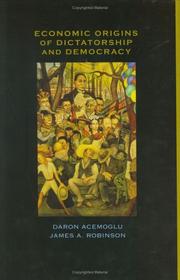
This paper develops a model where there is a trade-off between the enforcement of the property rights of different groups. An oligarchic society, where political power is in the hands of major producers, protects their property rights, but also tends to erect significant entry barriers, violating the property rights of future producers. Democracy, where political power is more widely diffused, imposes redistributive taxes on the producers, but tends to avoid entry barriers. When taxes in democracy are high and the distortions caused by entry barriers are low, an oligarchic society achieves greater efficiency. Nevertheless, because comparative advantage in entrepreneurship shifts away from the incumbents, the inefficiency created by entry barriers in oligarchy deteriorates over time. The typical pattern is therefore one of the rise and decline of oligarchic societies: of two otherwise identical societies, the one with an oligarchic organization will first become richer, but later fall behind the democratic society. I also discuss how democratic societies may be better able to take advantage of new technologies, and how the unequal distribution of income in an oligarchic society supports the oligarchic institutions and may keep them in place even when they become significantly costly to society. Keywords: democracy, economic growth, entry barriers, oligarchy, political economy, redistribution, sclerosis. JEL Classifications: P16, O10.
Ratings & reviews
Log in to rate or review this book.
No written reviews yet.
Discussions
Talk about this book with other readers.
Log in to start a discussion.
No discussions yet.
Editions
-
Format not known Massachusetts Institute of Technology, Dept. of Economics 2003 44 pages English Open Library

Details & links
- First published
- 2003
- Pages
- 44
- Languages
- Available in 1 language
Where to buy this book: see “Buy this book”
More about this book
Read a sample, borrow it or see other editions → openlibrary.org