Steven Arthur Pinker is a Canadian cognitive psychologist, psycholinguist, popular science author, and public intellectual. He is an advocate of evolutionary psychology and the computational theory of mind. Pinker is the Johnstone Family professor of psychology at Harvard University.
From Wikipedia · CC BY-SA 4.0
22 books in our catalogue.
2018
576 pages
★ 4.63 · 19
Politics & Society
Is the world really falling apart? Is the ideal of progress obsolete? Cognitive scientist Steven Pinker urges us to step back from the gory headlines and prophecies of doom, which play to our psychological biases. Instead, follow the data. In seventy-five graphs, Pinker shows that …
2002
528 pages
HistoryPsychology & Self-HelpScience & Nature
In The Blank Slate, Steven Pinker, one of the world's leading experts on language and the mind, explores the idea of human nature and its moral, emotional, and political colorings. With characteristic wit, lucidity, and insight, Pinker argues that the dogma that the mind has …
2011
802 pages
★ 3.82 · 11
Politics & SocietyPsychology & Self-Help
From Goodreads: Selected by The New York Times Book Review as a Notable Book of the Year The author of The New York Times bestseller The Stuff of Thought offers a controversial history of violence. Faced with the ceaseless stream of news about war, crime, …
1997
667 pages
Philosophy & ReligionPsychology & Self-HelpScience & Nature
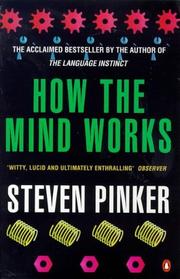
"Presented with extraordinary lucidity, cogency and panache...Powerful and gripping...To have read [the book] is to have consulted a first draft of the structural plan of the human psyche...a glittering tour de force" - Spectator "Why do memories fade? Why do we lose our tempers? Why …
1994
513 pages
★ 3.91 · 11
Language & ReferencePhilosophy & Religion
From the Preface... I have never met a person who is not interested in language. I wrote this book to try to satisfy that curiosity. Language is beginning to submit to that uniquely satisfying kind of understanding that we call science, but the news has …
2007
499 pages
Philosophy & ReligionPsychology & Self-HelpScience & Nature
New York Times bestselling author Steven Pinker possesses that rare combination of scientific aptitude and verbal eloquence that enables him to provide lucid explanations of deep and powerful ideas. His previous books—including the Pulitzer Prize finalist The Blank Slate—have catapulted him into the limelight as …
2014
368 pages
Language & Reference
A guide to writing English informed by recent scholarship (linguistics, cognative science, and such like).
2021
432 pages
Psychology & Self-Help
Like the subtitle says: what rationality is, the habits of mind that exhibit (and inhibit) rationality, and why wide-spread rationality is desirable.
1999
368 pages
Language & Reference
How does language work, and how do we learn to speak? Why do languages change over time, and why do they have so many quirks and irregularities? In this book, the profound mysteries of language are explored.
2007
387 pages
Science & Nature
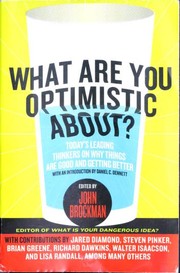
The nightly news and conventional wisdom tell us that things are bad and getting worse. Yet despite dire predictions, scientists see many good things on the horizon. John Brockman, publisher of Edge (www.edge.org), the influential online salon, recently asked more than 150 high-powered scientific thinkers …
2016
120 pages
Is humanity approaching a Golden Age, driven by technology and ever-closer global networks? Or is the notion of progress an illusion born in the West? From the Enlightenment onwards, the West has had an enduring belief that through the evolution of institutions, innovations, and ideas, …
1989
511 pages
Language & ReferencePsychology & Self-Help
Before Steven Pinker wrote bestsellers on language and human nature, he wrote several technical monographs on language acquisition that have become classics in cognitive science. Learnability and Cognition, first published in 1989, brought together two big topics: how do children learn their mother tongue, and …
2025
342 pages
Hypotheses about how common knowledge and knowledge of other people's knowledge of common knowledge shape social relations and organizations.
2004
240 pages
Science & Nature
1984
446 pages
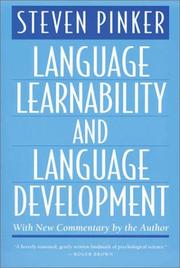
In this influential study, Steven Pinker develops a new approach to the problem of language learning. Now reprinted with new commentary by the author, this classic work continues to be an indispensable resource in developmental psycholinguistics. - Publisher.
1992
100 pages
Language & Reference
1986
285 pages
Psychology & Self-Help
2013
378 pages
Language & Reference
Pinker's seminal research explores the workings of language and its connections to cognition, perception, social relationships, child development, human evolution, and theories of human nature. This eclectic collection spans Pinker's thirty-year career, exploring his favorite themes in greater depth and scientific detail. It includes thirteen …