The plays of Euripides
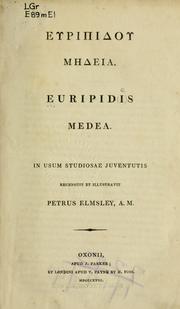
Medea
"Medea has been betrayed. Her husband, Jason, has left her for a younger woman. He has forgotten all the promises he made and is even prepared to abandon their two sons. But Medea is not a woman to accept such disrespect passively. Strongwilled and fiercely …

Orestes
Produced more frequently on the ancient stage than any other tragedy, Orestes retells with striking innovations the story of the young man who kills his mother to avenge her murder of his father. Though eventually exonerated, Orestes becomes a fugitive from the Furies (avenging spirits) …

Electra
Based on the conviction that only translators who write poetry themselves can properly recreate the celebrated and timeless tragedies of Aeschylus, Sophocles, and Euripides, the Greek Tragedy in New Translations series offers new translations that go beyond the literal meaning of the Greek in order …

Alcestis
"Euripides' Alcestic - perhaps the most anthologized Attic drama - is an ideal test for students reading their first play in the original Greek. Literary commentaries and language aids in most editions are too advanced or too elementary for intermediate students of the language, but …

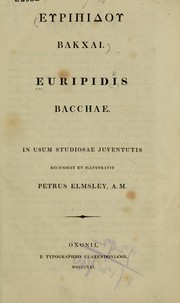
Bacchae
In Bacchae, one of the great masterpieces of the tragic genre, Euripides tells the story of king Pentheus' resistance to the worship of Dionysus and his horrific punishment by the god: dismemberment at the hands of Theban women. Iphigenia at Aulis recounts the sacrifice of …

Iphigenia in Tauris
This is the translation of the Euripides play about the princess Iphigeneia who narrowly avoided death by sacrifice at the hands of her father, Agamemnon. She was saved by the goddess Artemis, to whom the sacrifice was to be made, and swept off to Tauris. …
Biblioteca di classici greci
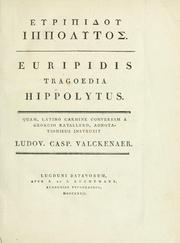
Hippolytus
Euripides wrote two plays called Hippolytus. In this, the second, he dramatized the tragic failure of perfection. This translation comes in two forms; the first presents a simulacrum of the text as it might have appeared in unprocessed form to a reader sometime shortly after …
Methuen classical Greek dramatists

Euripides
In nine paperback volumes, the Grene and Lattimore editions offer the most comprehensive selection of the Greek tragedies available in English. Over the years these authoritative, critically acclaimed editions have been the preferred choice of over three million readers for personal libraries and individual study …
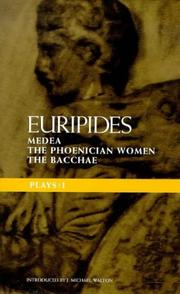
The complete Euripides


The Bacchae, and other plays
Ion, The women of Troy, Helen, The Bacchae.
[Morley's universal library

Standalone books

Grief Lessons
"Euripides, the last of the three great tragedians of ancient Athens, reached the height of his renown during the disastrous Peloponnesian War, when democratic Athens was brought down by its own outsized ambitions. His plays were shockers: he unmasked heroes, revealing them as foolish and …

The Greek Plays
A landmark anthology of the masterpieces of Greek drama, featuring all-new, highly accessible translations of some of the world’s most beloved plays, including Agamemnon, Prometheus Bound, Bacchae, Electra, Medea, Antigone, and Oedipus the King.

Hecuba
"In the three great war plays contained in this volume Euripides subjects the sufferings of Troy's survivors to a harrowing examination. The horrific brutality which both women and children undergo evokes a response of unparalleled intensity in the playwright whom Aristotle called the most tragic …
Phoenician women
The Phoenician Women is a tragedy by Euripides, based on the same story as Aeschylus' play Seven Against Thebes. It was presented along with the tragedies Hypsipyle and Antiope. With this trilogy, Euripides won the second prize. The title refers to the Greek chorus, which …


Ten plays / by Euripides ; translated by Moses Hadas and John McLean ; with an introd. by Moses Hadas
10 plays
The Greek playwright Euripedes was misunderstood in his own time, but the topics he chose to write about--women's role in society, war, religion, and the human condition--are still relevant today. This collection contains ten of his greatest works: "Alcestis," "Hippolytus," "Ion," "Electra," "Iphigenia at Aulis," …

Andromache
"In Andromache, Euripides challenges our concept of tragic character as he transforms our expectations of tragic structure. Through its subtly varied metrics, the play develops an increasingly complex plot and concludes with a simultaneous realization of realism and supernaturalism.". "The play takes place in the …
Three plays
Contains five plays written by ancient Greek poet Euripides in the period from 426 to 415 B.C., each influenced by the fierce struggle between Athens and Sparta.

Helen
Helen is a drama by Euripides about Helen, first produced in 412 BC for the Dionysia in a trilogy that also contained Euripides' lost Andromeda. The play has much in common with Iphigenia in Tauris, which is believed to have been performed around the same …


Βάκχαι
Pentheus has banned the wild, ritualistic worship of the god Dionysos. A stranger arrives to persuade him to change his mind. Euripides' electrifying tragedy is a struggle to the death between freedom and restraint, the rational and the irrational, man and god.


Greek Tragedy
Contains the three Greek tragedies Aeschylus's "Agamemnon," Sophocles' "Oedipus Rex," and Euripides' "Medea," with extracts from "Frogs" by Aristophanes and selections from Aristotle's "Poetics," and includes a chronology and detailed notes on each work.

Children of Heracles
This edition and commentary provides an introduction to one of Euripides' less well-known plays, and describes the enormous value of the text for our understanding of Athenian drama, religion, and society. Despite the excellent commentaries of Elmsley (1821) and Pearson (1907), and powerful articles by …

Herakles
Herakles is an Athenian tragedy by Euripides that was first performed c. 416 BC. While Heracles is in the underworld obtaining Cerberus for one of his labours, his father Amphitryon, wife Megara, and children are sentenced to death in Thebes by Lycus. Heracles arrives in …









Women on the edge
Women on the Edge, a collection of Alcestis, Medea, Helen, and Iphegenia at Aulis, provides a broad sample of Euripides' plays focusing on women, and spans the chronology of his surviving works, from the earliest, to his last, incomplete, and posthumously produced masterpiece. Each play …

Alcestis and other plays
Euripides' tragedies proved highly controversial even in his own lifetime, presenting his audience with unexpected twists of plot and violently extreme emotions; for many of today's readers and spectators, he seems almost uncannily modern in his insights. Euripides was the key figure in transforming the …
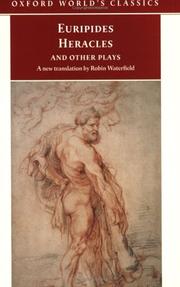
Alcestis, Heracles, children of Heracles, Cyclops
"Euripides wrote about timeless themes, of friendship and enmity, hope and despair, duty and betrayal. The first three plays in this volume are filled with violence or its threat, while the fourth, Cyclops, is our only surviving example of a genuine satyr play, with all …