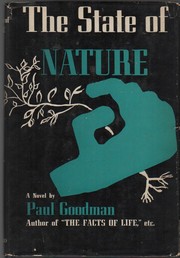
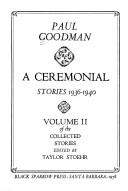
His The collected stories

Standalone books
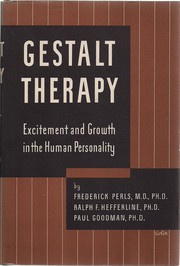
Gestalt Therapy
This edition contain an introductory note write by Frederick S. Perls

The Empire City
"Paul Goodman's Growing Up Absurd was a runaway best seller when it was first published in 1960, and it became one of the defining texts of the New Left. Goodman was a writer and thinker who broke every mold and did it brilliantly -- he …

The Structure of Literature
The Structure of Literature is a 1954 book of literary criticism by Paul Goodman, the published version of his doctoral dissertation in the humanities. The book proposes a mode of formal literary analysis that Goodman calls "inductive formal analysis": Goodman defines a formal structure within …


Speaking and language: defence of poetry
Speaking and Language: Defence of Poetry is a book of criticism by Paul Goodman that blames academic, structured approaches to linguistics for diminishing the role of creativity and spontaneity in speaking and human nature.
The May Pamphlet
The May Pamphlet is a collection of six anarchist essays written and published by Paul Goodman in 1945. Goodman discusses the problems of living in a society that represses individual instinct through coercion. He suggests that individuals resist such conditions by reclaiming their natural instincts …


The Paul Goodman Reader
A one man think-tank for the New Left, Paul Goodman is both a prolific writer and famed social critic. This compendious volume features excerpts not only from his bestselling titles such as Growing Up Absurd (Vintage, 1973), but also from his landmark books on education, …

Communitas
The Goodman brothers see a "community plan" not as a layout of streets and houses, but as the external form of the activity going on. "It is more like a choreography of society in motion and in rest, an arrangement for society to live out …
Crazy hope and finite experience
From the publication of Growing Up Absurd in 1960 until his death in 1972, Paul Goodman had the ear of the young radicals of the New Left, pouring forth books and articles on education, technology, decentralization, and of course, the war in Vietnam. Yet Goodman …

Drawing the Line Once Again
Five years after his death in 1972, Paul Goodman was characterized by anarchist historian George Woodcock as “the only truly seminal libertarian thinker in our generation.” In this new PM Press initiative, Goodman’s literary executor Taylor Stoehr has gathered together nine core texts from his …
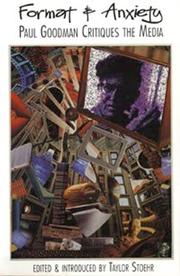
Format & Anxiety
Paul Goodman, anarchist critic and author of Growing Up Absurd and Communitas, never wrote a book devoted exclusively to media. Yet he thought the condition of popular arts and news services in America so desperate that by 1964 he was calling it a “constitutional crisis”#x14;by …

Freedom and order in the university
"Material...originally delivered in November 1965 in a symposium on freedom and order in the university, sponsored by the WRU-Case Program of Philosophical Studies."
New reformation
Emphasizing the importance of culture and the arts in society, this reprint of a 1960s classic?the author's last book of social criticism?includes a new introduction that situates the late Paul Goodman in his era and traces the development of his characteristic insights. The probing introduction …


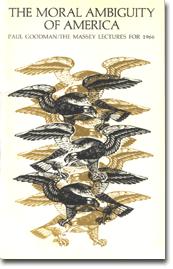
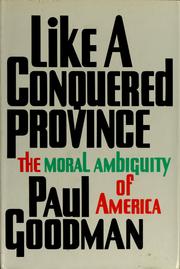
The moral ambiguity of America
Dr. Paul Goodman, social critic, talks about the problems of contemporary America in this 1966 Massey Lectures. Pt. 1: The Empty Society Pt. 2: Counter Forces for a Decent Society Pt. 3: Dr. Paul Goodman criticizes the purposelessness of much of our technology and its …