Bibliothèque de philosophie (Gallimard (Firm))


Prinzip Hoffnung
The Principle of Hope is a book by the Marxist philosopher Ernst Bloch, published in three volumes in 1954, 1955, and 1959, in which the author explores utopianism, studying the utopian impulses present in art, literature, religion and other forms of cultural expression, and envisages …
Standalone books
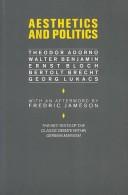
Aesthetics and Politics

Atheismus im Christentum
Atheism in Christianity: The Religion of the Exodus and the Kingdom (German: Atheismus im Christentum: Zur Religion des Exodus und des Reichs) is a 1968 book by German Marxist philosopher Ernst Bloch. The book offers a third way to the Christian/atheist either/or debate. Gareth Jenkins …


The utopian function of art and literature
The aesthetic essays of the philosopher Ernst Bloch (1885-1977) belong to the rich tradition of cultural criticism represented by Georg Lukacs, Theodor Adorno, and Walter Benjamin. Bloch was a significant creative source for these thinkers, and his impact is nowhere more evident than in writings …


Literarische Aufsatze
Bloch's literary essays are not, strictly speaking, "theoretical" pieces, certainly not applications to literature of some pre-existing conceptual apparatus. Collectively they represent a field of experiment in which a thinker of astonishing originality exposes his thought to the provocation of literary, musical, and artistic works, …


Traces
Spuren ist eine Prosasammlung des deutschen Philosophen Ernst Bloch (1885–1977). Das Buch wurde 1930 veröffentlicht und ist Teil seiner zu Lebzeiten erschienen Werkausgabe. Darin bildet es als Band 1 gleichsam einen Prolog. (Quelle: Wikipedia)
