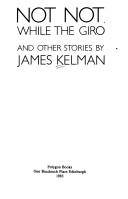
James Kelman is a Scottish novelist, short story writer, playwright and essayist. His fiction and short stories feature accounts of internal mental processes of usually, but not exclusively, working-class narrators and their labyrinthine struggles with authority or social interactions, mostly set in his home city of Glasgow. Frequently employing stream of consciousness experimentation, Kelman's stories typically feature "an atmosphere of gnarling paranoia, imprisoned minimalism, the boredom of survival."
From Wikipedia · CC BY-SA 4.0
18 books in our catalogue.
1994
373 pages
General Fiction
In Scotland, the portrait of a petty crook who had one run-in with police too many. It is a series of reflections as he sits in jail, contemplating his fate. He had been in trouble before, but this time it's different, the latest brawl with …
1985
237 pages
General Fiction
1989
337 pages
General Fiction
Patrick Doyle, a Glasgow schoolteacher drowning in despair, can no longer control his students or his life and retreats into the world of corrugated cardboard pipes--a musical sanctuary of his own invention.
2008
422 pages
Young Adult
Summary:Rejected by his brother and largely ignored by his parents, Kieron Smith finds comfort - and endless stories - in the home of his much-loved grandparents. But when his family move to a new housing scheme on the outskirts of the city, a world away …
2016
388 pages
General Fiction
After his mothers recent death, sixteen-year-old Murdo and his father travel from their home in rural Scotland to Alabama to be with his émigré uncle and American aunt. Stopping at a small town on their way from the airport, Murdo happens upon a family playing …
2003
320 pages
General Fiction
2014
280 pages
General Fiction
Collects short stories that penetrate the minds of characters in such everyday situations as convalescing in a hospital, sitting at a bus stop, and being in a living room with a vacuum cleaner.
1998
246 pages
Literary & Classics
"The twenty first-person narratives in The Good Times portray ordinary people in a language that makes a glory of their lives. The narrators are men and boys who come face-to-face with uncomfortable truths, whether musing on mortality, encountering betrayals both devastating and trivial, or struggling …
2016
384 pages
General Fiction
2002
340 pages
General Fiction
"The novel is set in an unnamed territory or country that appears to be under military rule. It is narrated in the first person, but the narrators remain anonymous, as do most of the other characters. The language used is an atypical English form, but …
2004
410 pages
General Fiction
Jeremiah Brown is a man of extremes.So when he nips out for a quick drink on the eve of returning to his native Scotland after twelve years in America, anything could happen. Anything at all. Just one quick drink to help him sleep but there's …
1995
308 pages
General Fiction
2021
304 pages
Psychology & Self-Help
2006
287 pages
Biography & MemoirPolitics & Society
1987
230 pages
Literary & Classics
Greyhound for Breakfast is a collection of short stories by the Scottish writer James Kelman first published in 1988. The collection was awarded the Cheltenham Prize for Literature in 1987.
1985
286 pages
General Fiction
1983
206 pages
General Fiction