Felipe Fernández-Armesto
1950–
Felipe Fernández-Armesto is a British professor of history and author of several popular works, notably on cultural and environmental history.
From Wikipedia · CC BY-SA 4.0
31 books in our catalogue.
1995
816 pages
History
Millennium is the most exciting sort of popular history. The narrative of Millennium begins in Japan in the year 1005 with a visit to the author of The Tale of Genji ... the same place it ends 990 years later. In between, it follows the …
2002
258 pages
Food & CookingHistory
2004
190 pages
History
"You think you're human. But what does that mean? How can humanity be defined? If our concept of humanity breaks down altogether, what will this mean for human values and human rights?" "Felipe Fernandez-Armesto confronts these problems from a historical perspective, showing that our present …
2009
346 pages
History
The world would end in 1492-so the prophets, soothsayers, and stargazers said. They were right. Their world did end. Ours began.In this extraordinary, sweeping history, Felipe Fernandez-Armesto traces key elements of the modern world back to that single, fateful year. Everything changed in 1492: the …
2000
656 pages
HistoryScience & Nature
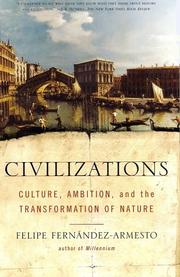
Erudite, wide-ranging, a work of dazzling scholarship written with extraordinary flair, Civilizations redefines the subject that has fascinated historians from Thucydides to Gibbon to Spengler to Fernand Braudel: the nature of civilization. To the author, Oxford historian Felipe Fernandez-Armesto, a society's relationship to climate, geography, …
2006
430 pages
History
Beginning with Homo erectus's migrations from East Africa to the rest of the continent and to Eurasia a million and a half years ago, the book examines how and why cultures spread throughout the world. Each section of the globe is examined, from the Tigris …
2001
312 pages
Food & CookingHistory
"The story of food is cultural as well as culinary. The history of how we produce, process, prepare and eat it encompasses ecology as well as gastronomy. In this book, the history is global. It ranges over half a million years, but Felipe Fernandez-Armesto always …
2004
190 pages
History
"Chimps and humans are objectively so alike that an anthropologist from Mars might classify them together; advances in artificial intelligence mean that humans no longer have exclusive access to reason, consciousness and imagination; developments in genetics threaten humanity with an uncertain future. The harder we …
2003
400 pages
HistoryPhilosophy & Religion
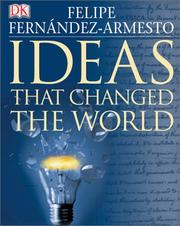
Presents the big themes in philosophy and history, and reveals how certain ideas have shaped our civilization. Respected historian Felipe Fernandez-Armesto offers an unashamedly personal analysis on a wide range of ideas--from the afterlife to taboo foods--that will keep readers enthralled.--From publisher description.
1988
300 pages
History
The "defeat" of the Spanish Armada by the Royal Navy in 1588 is a story every schoolchild knows. Linked in British history with the beginning of England's naval supremacy, it has been presented for years as a David-and-Goliath showdown in which the Armada, then the …
1997
324 pages
Philosophy & Religion
Almost from the moment Martin Luther tacked his theses to the door, Protestants and Catholics have disagreed violently on the question of the Reformation's merits - some Catholics have traced a direct line from the Reformation to Nietzsche and the death of God, while Protestants …
2006
231 pages
Biography & MemoirHistory
In 1507, European cartographers were struggling to redraw their maps of the world and to name the newly found lands of the Western Hemisphere. The name they settled on: America, after Amerigo Vespucci, an obscure Florentine explorer.In Amerigo, the award-winning scholar Felipe Fernandez-Armesto answers the …
2010
275 pages
Biography & Memoir
Presents Columbus's self-perception and personal history, as far as possible, in his own words.
2014
409 pages
HistoryPolitics & Society
Maps the influence of America's Hispanic past, from the explorers and conquistadors who helped colonize Puerto Rico and Florida, to the missionaries and rancheros who settled in California and the 20th-century resurgence in major cities like Chicago and Miami. The United States is still typically …
2015
294 pages
HistoryPhilosophy & ReligionPolitics & Society
We are a weird species. Like other species, we have a culture. But by comparison with other species, we are strangely unstable: human cultures self-transform, diverge, and multiply with bewildering speed. They vary, radically and rapidly, from time to time and place to place. And …
1992
218 pages
Biography & Memoir