A monetary history of the United States, 1867-1960
1963
860 pages
Business & EconomicsHistory
Historical developments of the last century are explained in terms of monetary theory.
Historical developments of the last century are explained in terms of monetary theory.
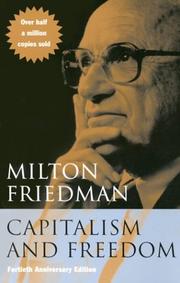
Selected by the Times Literary Supplement as one of the "hundred most influential books since the war"How can we benefit from the promise of government while avoiding the threat it poses to individual freedom? In this classic book, Milton Friedman provides the definitive statement of …
In this powerful and persuasive book two distinguished economists, Milton Friedman and his wife, Rose, unravel the mysteries of economics for the man or woman in the street (Wall Street or Main Street). They show us how our freedom has been eroded and our prosperity …
Two Lucky People is Milton and Rose Friedman's memorable and lively account of their lives, the people they knew, and the work they shared. For the first time they set the record straight regarding their involvement with world leaders and many of this century's most …
Milton Friedman's book Essays in Positive Economics (1953) is a collection of earlier articles by the author with as its lead an original essay "The Methodology of Positive Economics." This essay posits Friedman's famous, but controversial, principle that assumptions need not be "realistic" to serve …
Concentrates on the pricing of final products and the theory of distribution.
The background of monetary policy; The tools of the FRS; Debt management and banking reform; The goals and criteria of monetary policy.
"Based on two papers: 'A theoretical framework for monetary analysis,' and 'A monetary theory of nominal income,' [by M. Friedman] which appeared in the Journal of political economy, volume 78, number 2, and volume 79, number 2, respectively." Bibliography: p. 62-65.
"In this groundbreaking work, a Nobel Prize-winning economist addresses the consumption behavior of individuals and how it can be defined in a way that is supported by empirical evidence and useful for research and planning. Milton Friedman introduced a distinction between "measured income," what an …
In this book, Robert Leeson and Charles Palm have assembled an amazing collection of Milton Friedman’s best works on freedom. Even more amazing is that the selection represents only 1 percent of the 1,500 works by Friedman that Leeson and Palm have put online in …
In response to widespread interest in a formal complete statement analyzing aspects of the money-income relationship and clarification of his quantity theory, Milton Friedman in 1970 published "A Theoretical Framework for Monetary Analysis," and a year later "A Monetary Theory of Nominal Income," both in …
A description of the income structure of the professions of medicine, dentistry, law, accounting, and engineering during 1929-36.