The Modern library of the world's best books [43]

Standalone books
Discours de la méthode
By an almost universal agreement among philosophers and historians, Rene' Descartes is considered the originator of modern philosophy, or at least the first important philosopher of our times. If we add to this the common belief that philosophy points the way for developments in all …
Meditationes de prima philosophia
"Descartes's Meditations on First Philosophy, the fundamental and originating work of the modern era in Western philosophy, is presented here in Donald Cress's completely revised edition of his well-established translation, bringing this version even closer to Descartes's original, while maintaining its clear and accessible style." …

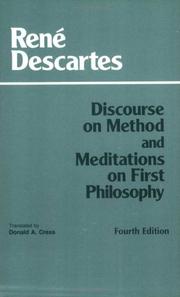
Discourse on Method and Meditations on First Philosophy, 4th Ed


Descartes
Review: 'This new translation is designed as a replacement for the old but still widely used translation by Elizabeth Haldane and G. R. T. Ross ... Unlike the Haldane and Ross edition which was translated from a composite text based on both the French and …
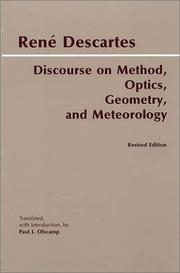
Discourse on the method for conducting one's reason well and for seeking truth in the sciences

Meditations on First Philosophy
Meditations on First Philosophy (1641)—full titles Meditations on First Philosophy, in which the existence of God and the immortality of the soul are demonstrated—is a philosophical treatise by French philosopher and mathematician René Descartes. First published in Latin, the book is made up of six …

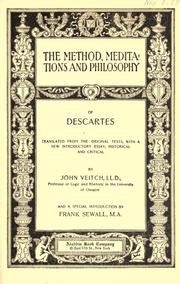
The method, meditations and philosophy of Descartes
The book is made up of six meditations, in which Descartes first discards all belief in things which are not absolutely certain, and then tries to establish what can be known for sure. The meditations were written as if he were meditating for 6 days: …


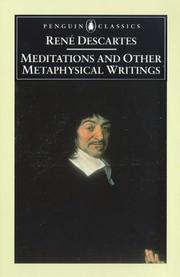
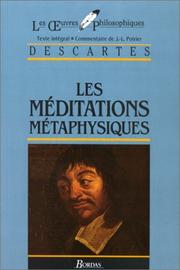
Meditations Metaphysiques
Meditations on First Philosophy, in which the existence of God and the immortality of the soul are demonstrated, often simply called Meditations on First Philosophy or the Meditations, is a philosophical treatise by René Descartes first published in Latin in 1641. The French translation was …

Discourse on the method of rightly conducting the reason, and seeking truth in the sciences


The Meditations, and selections from the Principles, of René Descartes (1596-1650)




A Discourse On The Method Of Correctly Conducting Ones Reason And Seeking Truth In The Sciences
"Descartes's A Discourse on the Method of Correctly Conducting One's Reason and Seeking Truth in the Sciences marks a watershed in European thought. In it, the author provides an informal intellectual autobiography in the vernacular for a non-specialist readership, sweeps away all previous philosophical traditions, …


Discourse on method and related writings
René Descartes was a central figure in the scientific revolution of the seventeenth century. In his Discourse on method he outlined the contrast between mathematics and experimental sciences, and the extent to which each one can achieve certainty. Drawing on his own work in geometry, …



Descartes, his moral philosophy and psychology
This volume presents material, most of it for the first time in English, that is requisite for any study of Descartes' moral philosophy and psychology. Descartes' reflections on moral philosophy and psychology were largely developed in correspondence with Princess Elisabeth (of Bohemia), Queen Christina (of …



Great Conversations 2
The story of Samson, Judges 13-16 / Anonymous Selected poems / John Dunne Meditations on first philosophy / René Descartes The nose / Nikolai Gogol Grand Inquisitor / Fyodor Dostoevsky Fall of the House of Usher / Edgar Allen Poe Bartleby the scrivener : a …


Les passions de l'ame
In his final philosophical treatise, The Passions of the Soul, completed in 1649 and dedicated to Princess Elisabeth of Bohemia, the French philosopher and mathematician René Descartes contributes to a long tradition of philosophical inquiry into the nature of "the passions". The passions were experiences …



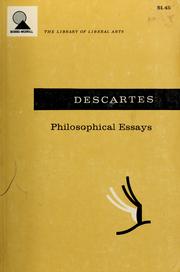
Philosophical essays: Discourse on method; Meditations; Rules for the direction of the mind


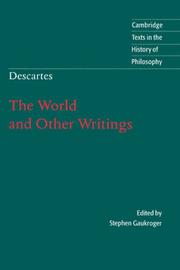


Descartes Meditations, Bro

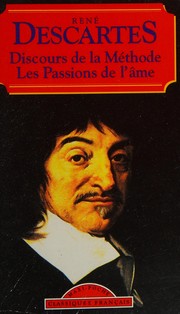

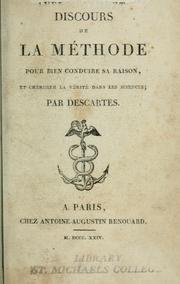
Discours de la méthode pour bien conduire sa raison, et chercher la vérité dans les sciences

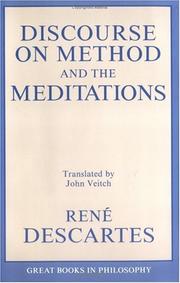


Discourse on the method for reasoning well and for seeking truth in the sciences


Discourse on the method of rightly conducting one 's reason and of seeking truth in the sciences

Discourse on the method of rightly conducting the reason, and seeking the truth in the sciences ..





Meditationen über die Erste Philosophie / Meditationes de Prima Philosophia. Zweisprachige Ausgabe. Lateinisch / Deutsch


Philosophical Essays and Correspondence (Descartes) (Hackett Publishing Co.)
Règles pour la direction de l'esprit
Regulae ad directionem ingenii, or Rules for the Direction of the Mind is an unfinished treatise regarding the proper method for scientific and philosophical thinking by René Descartes. Descartes started writing the work in 1628, and it was eventually published in 1701 after Descartes' death. …
Régles utiles et claires pour la direction de l'esprit en la recherche de la vérité
xvi, 345 p. ; 25 cm
Rules for the direction of the mind. Discourse on the method. Meditations on first philosophy. Objections against the meditations and replies. [translated by Elizabeth S. Haldane and G. R. T. Ross]. The geometry. [translated by David Eugene Smith and Marcia L. Latham]

The essential writings [of] René Descartes
"Rene Descartes is often called the 'Father of Modern Philosophy.' The profound controversies that his doctrines have engendered are alone sufficient to establish his eminence. Yet if he is to be paid a due respect, it is necessary to understand him on his own terms- …