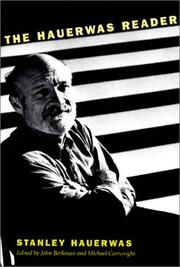
Stanley Martin Hauerwas is an American Protestant theologian, ethicist, and public intellectual.
From Wikipedia · CC BY-SA 4.0
29 books in our catalogue.
1981
309 pages
Philosophy & Religion
"Recognized as a leading theological ethicist, Stanley Hauerwas applies his theory of the narrative formation of Christian character to the field of social ethics. He advances his ideas by showing why any consideration cannot be divorced from the kind of community the church is and …
1989
175 pages
Philosophy & Religion
Resident Aliens: Life in the Christian Colony is a 1989 book authored by the theologians Stanley Hauerwas and William Willimon. The book discusses the nature of the church and its relationship to surrounding culture. It argues that churches should focus on developing Christian life and …
2001
729 pages
Hauerwas ... is one of the most influential Christian theologians in academe today. ... Since taking up his current line of work, Mr. Hauerwas has published hundreds of scholarly papers about ethics, narrative, and the postmodern condition. A sturdy wall of them has been mortared …
1986
231 pages
Philosophy & Religion
"Stanley Hauerwas challenges the dominant paradigm of contemporary ethics and views the moral crisis in medicine in this excellent collection of essays. He provides fresh insights into such diverse issues as whether the goal of medicine is to forestall death, how moral relations in a …
1983
184 pages
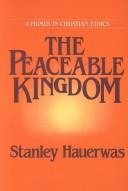
Examines Christian ethics in a fragmented and violent world. Considers historical perspectives and the task of ethics. Focuses on the peaceable kingdom, the servant community, and the spirituality of peaceableness.
2011
188 pages
Philosophy & ReligionPolitics & Society
How are American identity and America's presence in the world shaped by war, and what does God have to do with it? Esteemed theologian Stanley Hauerwas helps readers reflect theologically on war, church, justice, and nonviolence in this compelling volume, exploring issues such as how …
2001
256 pages
These lectures explore how natural theology, divorced from a confessional doctrine of God, inevitably distorts our understanding of God's character and the world in which we live. Hauerwas criticizes those who use natural theology to defend theism as the philosophical prerequisite to confessional claims. Instead, …
1985
208 pages
Philosophy & Religion
1975
239 pages
Philosophy & Religion
2010
282 pages
Philosophy & Religion
2004
205 pages
Philosophy & Religion
2002
226 pages
Politics & Society
1994
161 pages
Philosophy & Religion
2003
310 pages
Philosophy & Religion
1990
161 pages
Philosophy & ReligionPsychology & Self-Help
Drawing heavily on stories of ill and dying children to illustrate and clarify his discussion of theological issues, Stanley Hauerwas explores why we seek explanations for suffering and evil so desperately in today's world. Modern medicine, he declares, has too often become a noisy way …
2004
254 pages
HistoryPhilosophy & Religion
1999
132 pages
Philosophy & Religion
1983
286 pages
Philosophy & Religion
2016
304 pages
Philosophy & Religion
"In Sanctify them in the Truth Stanley Hauerwas provides an overview of the development of theology and ethics. He considers how the two disciplines interrelate, discusses the nature of sin, how any account of sin requires a more determinative account of moral law, the nature …
1984
72 pages
Philosophy & Religion
2013
216 pages
Philosophy & Religion
2015
100 pages
Philosophy & Religion
1999
144 pages
Philosophy & Religion
Analyzes each of the Ten Commandments and discusses what they tell us about God. Describes how God loves mankind enough to take interest in the real issues of daily life such as property, sex, and speech.
1999
494 pages
Philosophy & Religion
2015
305 pages
A "how-to" book on theology from a world-renowned theologian. Revisiting some of his earliest philosophical and theological views in order to clarify his previous work — and to correct mistaken characterizations of him and his work — Hauerwas here explores theological reflection as an exercise …
1993
159 pages
Philosophy & ReligionPolitics & Society
In this challenging, controversial volume, Stanley Hauerwas asserts that both liberal (historical-critical) and fundamentalist (literal) approaches to biblical scholarship have corrupted our use of the Bible - especially in preaching - in the American church. He argues that the Bible can be understood only in …