
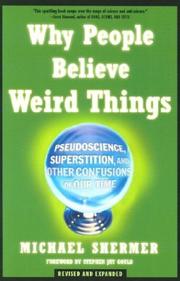
Why people believe weird things
Why People Believe Weird Things: Pseudoscience, Superstition, and Other Confusions of Our Time is a 1997 book by science writer Michael Shermer. The foreword was written by Stephen Jay Gould.


How We Believe
"Recent polls report that 96% of Americans believe in God. Why is this? Why, despite the rise of science, technology, and secular education, are people turning to religion in greater numbers than ever before? Why do people believe in God at all?"--BOOK JACKET. "These provocative …


The believing brain
Shermer demonstrates how our brains selectively assess data in an attempt to confirm the conclusions (beliefs) we've already reached. Drawing on evolution, cognitive science, and neuroscience, he considers not only supernatural beliefs but political and economic ones as well.


Denying history
Denying History takes a bold and in-depth look at those who say the Holocaust never happened and explores the motivations behind such claims. While most commentators have dismissed the Holocaust deniers as antisemitic neo-Nazi thugs who do not deserve a response, historians Michael Shermer and …

The mind of the market
In this eye-opening exploration, author and psychologist Michael Shermer uncovers the evolutionary roots of our economic behavior. Drawing on the new field of neuroeconomics, Shermer investigates what brain scans reveal about bargaining, snap purchases, and establishing trust in business. He scrutinizes experiments in behavioral economics …

The moral arc
"From Galileo and Newton to Thomas Hobbes and Martin Luther King, Jr., thinkers throughout history have consciously employed scientific techniques to better understand the non-physical world. The Age of Reason and the Enlightenment led theorists to apply scientific reasoning to the non-scientific disciplines of politics, …

The Science of Good and Evil
The Science of Good and Evil: Why People Cheat, Gossip, Care, Share, and Follow the Golden Rule is a 2004 book by author Michael Shermer that examines the transition of humans from creatures driven by social instincts to those governed by moral considerations. The book …
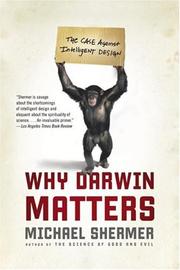
Why Darwin Matters
Why Darwin Matters: The Case Against Intelligent Design is a 2006 book by Michael Shermer, an author, publisher, and historian of science. Shermer examines the theory of evolution and the arguments presented against it. He demonstrates that the theory is very robust and is based …

The Borderlands of Science
"As author of the bestselling Why People Believe Weird Things and How We Believe, and Editor-In-Chief of Skeptic magazine, Michael Shermer has emerged as the nation's number one scourge of superstition and bad science. Now, in The Borderlands of Science, he takes us to the …

UFOs, Chemtrails, and Aliens



Science friction
"In each of the essays in Science Friction, psychologist and science historian Michael Shermer explores the barriers and biases that plague and propel science, especially when scientists push against the boundaries of the unknown. As Shermer puts it, the challenge we all face in distinguishing …
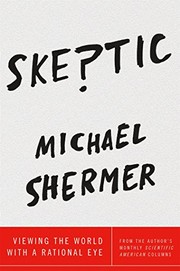
Skeptic
Seventy-five of author's contributions to Scientific American magazine.


