Thomas Stephen Szasz
1920–2012
Thomas Stephen Szasz was a Hungarian-American academic and psychiatrist. He served for most of his career as professor of psychiatry at the State University of New York Upstate Medical University. A distinguished lifetime fellow of the American Psychiatric Association and a life member of the American Psychoanalytic Association, he was best known as a social critic of the moral and scientific foundations of psychiatry, as what he saw as the social control aims of medicine in modern society, as well as scientism.
From Wikipedia · CC BY-SA 4.0
38 books in our catalogue.
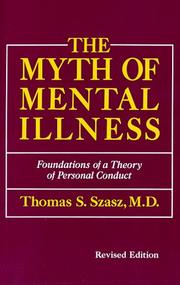
1961
320 pages
Philosophy & ReligionPsychology & Self-Help
The author believes that what is nowadays accepted as mental illness is whatever psychiatrists say it is - and that psychiatry has, with increasing zeal, defined more and more kinds of behavior as mental illness. What is termed mental illness is in fact behavior disapproved …
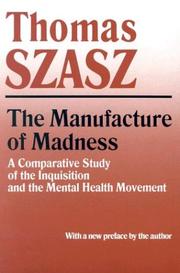
1970
383 pages
Politics & SocietyPsychology & Self-Help
Intends to show that the belief in mental illness and the social actions to which it leads have the same moral implications and political consequences as had the belief in witchcraft and the social actions to which it led.
1987
414 pages
Psychology & Self-Help
The idea of "insanity" pervades every aspect of our daily lives. Here, Szasz contends that the term actually functions as a euphemism for problems in living, as an excuse for crime and misbehaviour, as a stigma for invalidating adversaries - and, generally, as a metaphor …
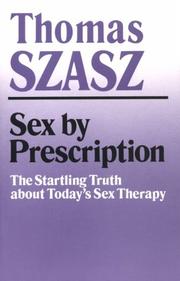
1978
237 pages
HistoryPhilosophy & ReligionPsychology & Self-Help
1974
243 pages
xxi, 290 p. ; 21 cm
1999
177 pages
Philosophy & Religion
"One of the most troubling issues we face today is who should control when and how we die. Fatal Freedom is an eloquent defense of every individual's right to choose a voluntary death. Thomas Szasz, a psychiatrist, believes that we can speak about suicide calmly …
1990
180 pages
Philosophy & ReligionPsychology & Self-Help
1992
199 pages
Politics & Society
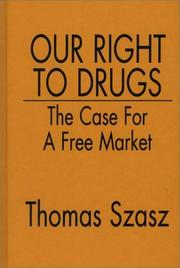
"In Our Right to Drugs, Thomas Szasz shows that our present drug war started at the beginning of this century, when the U.S. government first assumed the task of protecting people from patent medicines. By the end of World War I, however, the free market …
2018
160 pages
Philosophy & Religion
"For more than half a century Thomas Szasz has devoted much of his career to a radical critique of psychiatry. His latest work, Psychiatry: The Science of Lies, is a culmination of his life's work: to portray the integral role of deception in the history …
1976
237 pages
Philosophy & Religion
1973
372 pages
HistoryPsychology & Self-Help
"The first full scale attack on the conception of psychoanalysis or psychotherapy as a branch of medicine was made by Thomas Szasz." --Cover p. [2].
1974
226 pages
Psychology & Self-Help
1996
182 pages
Philosophy & ReligionPsychology & Self-Help
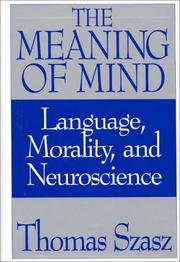
In The Meaning of Mind, Thomas Szasz argues that only as a verb does the word "mind" name something in the real world, namely, attending or heeding. Minding is the ability to pay attention and adapt to one's environment by using language to communicate with …
1976
206 pages
Psychology & Self-Help
xii, 183 p. ; 18 cm
1984
360 pages
Politics & Society
Chiefly reprints of articles originally published 1965-1983. Includes bibliographies and index.
2004
258 pages
Language & ReferencePhilosophy & ReligionPsychology & Self-Help
1976
180 pages
HistoryPhilosophy & ReligionPsychology & Self-Help
1977
159 pages
Politics & SocietyPsychology & Self-Help
1982
253 pages
Philosophy & ReligionPsychology & Self-Help
"The complete list of the works of Thomas S. Szasz": p. 237-253.
1993
202 pages
Language & ReferencePolitics & SocietyPsychology & Self-Help
2004
264 pages
Business & EconomicsPhilosophy & ReligionPolitics & Society
2005
377 pages
Psychology & Self-Help
Nell'arco di qualche secolo, le società occidentali si sono trasformate da teocrazie in democrazie e da democrazie in farmacrazie. Nel libro ricostruisco la storia di questa trasformazione e descrivo la natura collettivistico-totalitaristica dello stato terapeutico, legittimato dall'imperante farmacrazia.
2011
132 pages
Philosophy & ReligionPsychology & Self-Help
Examination and critique of contemporary anti-suicide policies that are based on the notion that voluntary death is a mental health problem, and systematically lays out the dehumanizing consequences of psychiatrizing suicide prevention.