Mary Jean Alexandra Fulbrook, is a British academic and historian. Since 1995, she has been Professor of German History at University College London. She is a noted researcher in a wide range of fields, including religion and society in early modern Europe, the German dictatorships of the twentieth century, Europe after the Holocaust, and historiography and social theory.
From Wikipedia · CC BY-SA 4.0
17 books in our catalogue.
1990
271 pages
History
Provides a crisp synthesis of a vast array of historical material, and explores the interrelationships between social, political and cultural factors in the light of scholarly controversies.
1995
307 pages
HistoryPolitics & Society
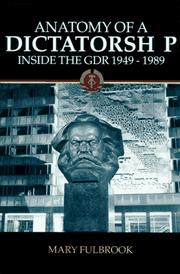
Founded on the ruins of Hitler's defeated Third Reich, and lacking any intrinsic legitimacy, the German Democratic Republic nevertheless became the most stable and successful state in the Soviet bloc. Yet in the 'gentle revolution' of 1989 it collapsed with startling speed. How can this …
2006
352 pages
Politics & Society
"What was life really like for East Germans, effectively imprisoned behind the Iron Curtain? The headline stories of Cold War spies and surveillance by the secret police, of political repression and corruption, do not tell the whole story. After the unification of Germany in 1990 …
2012
421 pages
Biography & MemoirHistory
The Silesian town of Be̜dzin lies a mere twenty-five miles from Auschwitz. Through its linked ghettos and that of its neighboring town, some 85,000 Jews passed on their way to slave labor or the gas chambers. The principal civilian administrator of Be̜dzin, Udo Klausa, was …
1992
405 pages
Politics & Society
"Covering all major aspects of German history from the Weimar Republic through reunification, this new book offers a remarkably rich, insightful survey of a difficult and controversial subject. It integrates East German history more fully than any previous account, offering a precisely nuanced picture of …
1999
248 pages
Politics & Society
1992
114 pages
Politics & Society
1996
240 pages
Politics & Society
Throughout Europe longstanding ideas of what it means to be a citizen are being challenged. The sense of belonging to a nation has never been more in flux. Simultaneously, nationalistic and racist movements are gaining ground and barriers are being erected against immigration. Citizenship, Nationality …
2002
234 pages
HistoryPhilosophy & Religion
2002
352 pages
HistoryPolitics & Society
"Traces the dramatic social, cultural and political tensions in Germany since 1918... from the self-destructive Weimar Republic, through the extremes of genocide and military aggression in the Nazi era, to the extraordinary political esperimentation of division of the nation in the Cold War, culminating in …
2009
386 pages
Politics & Society
2004
64 pages
Biography & MemoirChildren'sHistory
2000
114 pages
Business & EconomicsHistoryPolitics & Society
"Arising from the unpromising ashes of defeated Nazi Germany, the two Germanies came to represent opposing modes of state and society. The Federal Republic established itself as a remarkably stable democracy and successful social market economy; the German Democratic Republic developed an apparently exemplary form …