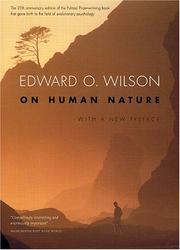
On human nature
1978
260 pages
HistoryPolitics & SocietyScience & Nature
Presents a philosophy based on sociobiological theory and applying the theory of natural selection to human society.
Presents a philosophy based on sociobiological theory and applying the theory of natural selection to human society.
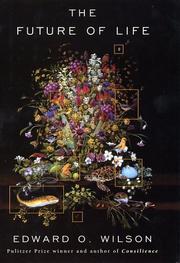
"In this book a master scientist tells the great story of how life on earth evolved. Edward O. Wilson eloquently describes how the species of the world became diverse, and why the threat to this diversity today is beyond the scope of anything we have …
Reviews in detail all topics in the anatomy, physiology, social organization, ecology, and natural history of ants.
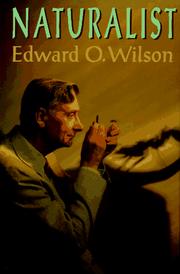
The eminent biologist reflects on his own response to nature and the aesthetic aspects of his exploration of natural systems in an intensely personal essay that examines the essential links between mankind and the rest of the living world.
"In this new book, the American biologist Edward O. Wilson argues for the fundamental unity of all knowledge and the need to search for consilience - the proof that everything in our world is organized in terms of a small number of fundamental natural laws …
"Refashioning the story of human evolution, Edward O. Wilson draws on his remarkable knowledge of biology and social behavior to demonstrate that group selection, not kin selection, is the premier driving force of human evolution. In a work that James D. Watson calls "a monumental …
Advice to talented and ambitious young people of what they need to know to succeed in science.
Half-Earth proposes an achievable plan to save our imperiled biosphere: devote half the surface of the Earth to nature. In order to stave off the mass extinction of species, including our own, we must move swiftly to preserve the biodiversity of our planet, says Edward …
"Biophilia" is the term coined by Edward O. Wilson to describe what he believes is humanity's innate affinity for the natural world. In his landmark book Biophilia, he examined how our tendency to focus on life and lifelike processes might be a biologically based need, …
"In this book, Wilson describes what treasures of the natural world we are about to lose forever - in many cases animals, insects, and plants we have only just discovered, and whose potential to nourish us, protect us, and cure our illnesses is immeasurable - …
Sociobiology: The New Synthesis is a book by the biologist E. O. Wilson. It helped start the sociobiology debate, one of the great scientific controversies in biology of the 20th century and part of the wider debate about evolutionary psychology and the modern synthesis of …
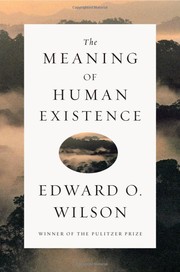
How did humanity originate and why does a species like ours exist on this planet? Do we have a special place, even a destiny in the universe? Where are we going, and perhaps, the most difficult question of all, "Why?" In The Meaning of Human …
A study of insect sociology, presenting individual investigations of wasps, ants, bees, and termites, and discussing caste, behavior, communication, symbioses, and other topics. "This first comprehensive study of social insects since the 1930s includes more than 250 illustrations and covers all aspects of classification, evolution, …
From the Pulitzer Prize-winning authors of The Ants comes this dynamic and visually spectacular portrait of Earth's ultimate superorganism. The Leafcutter Ants is the most detailed and authoritative description of any ant species ever produced. With a text suitable for both a lay and a …
Edward O. Wilson -- University Professor at Harvard, winner of two Pulitzer prizes, eloquent champion of biodiversity -- is arguably one of the most important thinkers of the twentieth century. His career represents both a blueprint and a challenge to those who seek to explore …
Anthill: A Novel is a 2010 novel by the biologist Edward O. Wilson. His first extended work of fiction, it won the Chicago Tribune's Heartland Prize for fiction.
Like Rachel Carson's Silent Spring, this is a book about the fate of the earth and the survival of our planet. Wilson attempts to bridge the seemingly irreconcilable worlds of fundamentalism and science. Passionately concerned about the state of the world, he draws on his …
In this profound and lyrical book, one of our most celebrated biologists offers a sweeping examination of the relationship between the humanities and the sciences: what they offer to each other, how they can be united, and where they still fall short.
Perhaps more than any other scientist of our century, Edward O. Wilson has scrutinized animals in their natural settings, tweezing out the dynamics of their social organization, their relationship with their environments, and their behavior, not only for what it tell us about the animals …
"E.O. Wilson, one of the most celebrated scientists in the United States, shows why biodiversity is vital to the future of Earth and to our own species through the story of an African national park that may be the most diverse place on earth, in …
Based on a lifetime of pioneering research, preeminent naturalist Edward O. Wilson gives us a new history of human evolution, presented in an elegant and provocative narrative that promises to have reverberations in fields as diverse as anthropology and social psychology, neuroscience and 21st-century intellectual …
A landmark collected edition of the Pulitzer Prize-winning author and world-renowned biologist, illuminating the marvels of biodiversity in a time of climate crisis and mass extinction. Library of America presents three environmental classics from two-time Pulitzer Prize-winner E. O. Wilson, a masterful writer-scientist whose graceful …
A twenty-first-century philosophical argument against mechanistic views of human life outlines expansive and advanced theories on human behavior to consider how humans are supremely different from all other species.
Both the misery and the majesty of modern publishing, it seems to me, are equal justifications for anthologies like this one. Simply put, there is more good writing out there than ever before, and it is harder and harder to find it. And if that's …
Before the transition in forestry can be made from conventional approaches of the past century to the ecosystem approach of the next, a consensus must be reached on the meaning of "sustainable forestry." Defining Sustainable Forestry presents the results of a national conference convened by …
Studying animal behavior to understand human behavior. "For eons, humanity's greatest minds--philosophers, theologians, and scientists--have lacked confirmable answers to the questions that define and explain the meaning of human existence: what we are and what created us. In [this book], Edward O. Wilson, examining evolutionary …
Increasingly absorbed in recent years by advances in our understanding of the origin of life, evolutionary history, and the advent of human kind, eminent biologist Christian de Duve has pondered the future of life on this planet. Focusing on the process of natural selection, de …
Species of the genus Pheidole are the most abundant and diverse ants of the New World and range from the northern United States to Argentina. In this richly illustrated book, Edward O. Wilson untangles its classification for the first time, characterizing all 625 known species, …
"Biogeography was stuck in a "natural history phase" dominated by the collection of data, the young Princeton biologists Robert H. MacArthur and Edward O. Wilson argued in 1967. In this book, the authors developed a general theory to explain the facts of island biogeography. The …
"Two-time Pulitzer Prize winner Edward O. Wilson is one of the leading biologists and philosophical thinkers of our time. In this compelling collection, Wilson's observations range from the tiny glands of ants to the nature of the living universe. Many of the pieces are considered …
Edward O. Wilson, renowned scientist and proponent of "consilience" or the unity of knowledge, finds an ardent interlocutor in Robert Hass, whose credo as U.S. poet laureate was "imagination makes communities." As they explore the many ways that poetry and science enhance each other, they …
"From the veteran New Yorker staff writer and award-winning author of The Experience of Place: an urgent, resounding call to protect half the earth's land--and thereby millions of its species--by 2050, that gives us the tools to think big about the planet and our role …
Professor Edward O. Wilson was elected by the ECI Jury chaired by Professor Sir Richard Southwood (University of Oxford, England) for his professional excellence in numerous publications, especially in the fields of population biology, biogeography, sociobiology, biodiversity, and evolutionary biology. Ed Wilson was born in …