James Rufus Agee was an American novelist, journalist, poet, screenwriter and film critic. In the 1940s, writing for Time, he was one of the most influential film critics in the United States. His autobiographical novel, A Death in the Family (1957), won the author a posthumous 1958 Pulitzer Prize. Agee is also known as a co-writer of the book Let Us Now Praise Famous Men and as the screenwriter of the film classics The African Queen and The Night of the Hunter.
From Wikipedia · CC BY-SA 4.0
16 books in our catalogue.
1957
339 pages
General Fiction
Forty years after its original publication, James Agee's last novel seems, more than ever, an American classic. For in his lyrical, sorrowful account of a man's death and its impact on his family, Agee painstakingly created a small world of domestic happiness and then showed …
1941
471 pages
HistoryTravel
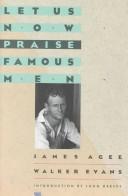
Let Us Now Praise Famous Men is a book with text by American writer James Agee and photographs by American photographer Walker Evans, first published in 1941 in the United States. Let Us Now Praise Famous Men grew out of an assignment the two men …
1958
432 pages
Art & PhotographyHistory
"James Agee was passionately involved with the movies throughout his life. A master of both fiction and nonfiction, he wrote about film in clean, smart prose as the reviewer for Time magazine and as a columnist for The Nation. Agee was particularly perceptive about the …
1965
452 pages
HistoryTravel
1950
120 pages
Young Adult
The Morning Watch explores the thoughts and feelings of 12-year-old Richard, a student at an unnamed Episcopal boarding school (based on Agee's schooling at St. Andrew's-Sewanee School in Sewanee, Tennessee), over the course of a few hours in the early morning of Good Friday in …
1934
59 pages
Poetry & Drama
1962
265 pages
Art & Photography
1968
179 pages
Poetry & Drama
2005
50 pages
Travel
"In 1939, James Agee was assigned by Fortune magazine to write an article on Brooklyn for a special issue on New York City. His draft was rejected for creative differences, and remained unpublished until it appeared in Esquire in 1968 under the title "Brooklyn Is: …
2005
463 pages
"Novelist, journalist, film critic, poet, and activist James Agee (1909-1955) produced an impressive array of literary works spanning three decades. His poems, novels, essays, works of criticism, and screenplays gave profound social insights into the Depression-ridden 1930s and war-torn 1940s, and scholars study and debate …