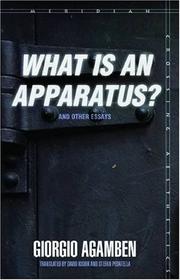
Giorgio Agamben is an Italian philosopher whose work spans political theory, ontology, aesthetics, and literature. He is best known for developing the concept of homo sacer and exploring the relationship between sovereignty, legal authority, and what he calls 'bare life'. His writings draw on sources including Aristotle, Roman law, Christian theology, Martin Heidegger, Walter Benjamin, Ludwig Wittgenstein, St. Augustine and Carl Schmitt among others, and engage critically with Michel Foucault’s account of biopolitics and biopower.
From Wikipedia · CC BY-SA 4.0
22 books in our catalogue.
1966
137 pages
Art & Photography
Twombly's photographic oeuvre, which did not achieve recognition until late, spans more than sixty years of his career. In this catalogue around a hundred unpublished photographs selected,(just before his death), by the artist himself, he also did the book design. The photographs are accompanied by …
1995
212 pages
Politics & Society
2013
157 pages
HistoryPhilosophy & Religion
What is a rule, if it appears to become confused with life? And what is a human life, if, in every one of its gestures, of its words, and of its silences, it cannot be distinguished from the rule? It is to these questions that …
1999
137 pages
Art & PhotographyPhilosophy & Religion
In this book, one of Italy's most important and original contemporary philosophers considers the status of art in the modern era. He takes seriously Hegel's claim that art has exhausted its spiritual vocation, that it is no longer through art that Spirit principally comes to …
1993
203 pages
HistoryPhilosophy & Religion
2013
66 pages
In 1900, art historians André Jolles and Aby Warburg constructed an experimental dialogue in which Jolles supposed he had fallen in love with the figure of a young woman in a painting: 'A fantastic figure - shall I call her a servant girl, or rather …
2005
114 pages
Art & PhotographyPhilosophy & Religion
"In Profanations, Agamben has assembled some of his essays on photography, the novel, and film. A meditation on memory and oblivion, on what is lost and what remains, Profanations proves yet again that Agamben is one of the most provocative writers of our time. In …
1993
105 pages
Philosophy & Religion
2003
408 pages
Politics & Society
1991
124 pages
Philosophy & Religion
Explores the symbiosis of philosophy and literature in understanding negativity.
1999
176 pages
Philosophy & Religion
2005
197 pages
Philosophy & Religion
In The Time That Remains, Agamben seeks to separate the Pauline texts from the history of the Church that canonized them, thus revealing them to be "the fundamental messianic texts of the West." He argues that Paul's letters are concerned not with the foundation of …
2004
176 pages
Language & ReferencePhilosophy & Religion
2009
168 pages
Philosophy & Religion
2011
121 pages
Philosophy & Religion
2016
170 pages
HistoryPolitics & Society
1999
287 pages
Poetry & Drama