Murray Bookchin
1921–2006
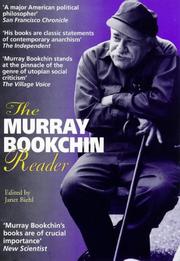
Murray Bookchin was an American social theorist, author, orator, historian, and political philosopher. Influenced by the works of G. W. F. Hegel, Karl Marx, and Peter Kropotkin, he was a pioneer in the environmental movement. Bookchin formulated and developed the theory of social ecology and urban planning within anarchist, libertarian socialist, and ecological thought. He was the author of two dozen books covering topics in politics, philosophy, history, urban affairs, and social ecology.
From Wikipedia · CC BY-SA 4.0
24 books in our catalogue.
1982
491 pages
HistoryPhilosophy & Religion
"Using a synthesis of ecology, anthropology, philosophy and political theory, this book traces our society's conflicting legacies of freedom and domination, from the first emergence of human culture to today's global capitalism. The theme of Murray Bookchin's grand historical narrative is straightforward: environmental, economic and …
1971
288 pages
"In this series of related essays, Murray Bookchin balances his ecological and anarchist vision with the promising opportunities of a 'post-scarcity' era. Surpassing the constraints of Marxist political economy--which was rooted in an era of material scarcity and could not forsee the sweeping changes ahead--Bookchin …
1989
222 pages
Politics & Society
According to Murray Bookchin, a humane solution to the climate crisis—a crisis he was among the first to identify—will require replacing industrial capitalism with an egalitarian, ecological society, decentralized democratic communities, and sustainable technologies like solar power, organic agriculture, and humanly scaled industries. Since he …
2015
279 pages
Politics & Society
"Many similarities exist between the new movements against austerity that have emerged since 2011, ranging from Taksim Square in Turkey to the Chilean student protests, and from Greece to NYC. One of them is their return to the principles of direct democracy and their organization …
1977
344 pages
HistoryPolitics & Society
The seminal history of Spanish anarchism: from its earliest inception to the organizations that claimed over two million members on the eve of the 1936 Revolution.
1973
192 pages
Art & Photography
1995
86 pages
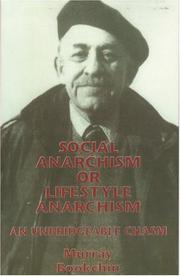
This book asks—and tries to answer—several basic questions that affect all Leftists today. Will anarchism remain a revolutionary social movement or become a chic boutique lifestyle subculture? Will its primary goals be the complete transformation of a hierarchical, class, and irrational society into a libertarian …
1962
285 pages
Politics & Society
lxxvii, 305 p. ; 21 cm
1980
315 pages
Politics & Society
1991
336 pages
Murray Bookchin introduces provocative ideas about the nature of community and what it means to be a fully empowered citizen. He believes that the tensions that exists between rural and urban society can be a vital source of human creativity, thereby defining a new, richly …
1993
80 pages
For the anarchist movement, the 1990s saw a period of defence against capital’s accelerating embrace of environmental destruction which helped to define the movement through to today. Discourse ranged from a red embrace of automation and demands for a new society based on rapid industrial …
1974
192 pages
Business & EconomicsHistoryPolitics & Society
The Anarchist Collectives: Workers’ Self-Management in the Spanish Revolution, 1936–1939 is a collection of essays about the Spanish Revolution of 1936. Edited by Sam Dolgoff, it features contributions by Murray Bookchin, Isaac Puente, Gaston Leval, Augustin Souchy, José Peirats, Alardo Prats and H.E. Kaminski. It …
1986
194 pages
Business & Economics
1900
187 pages
Politics & Society
Best known for introducing the idea of ecology to the Left, and for first positing that a liberatory society would also have to be an ecological society, Murray Bookchin, over the course of several decades, developed the basic components of "libertarian municipalism" – how to …
1994
75 pages
Philosophy & Religion