Franciscus Bernardus Maria de Waal was a Dutch-American primatologist and ethologist. He was the Charles Howard Candler Professor of Primate Behavior in the Department of Psychology at Emory University in Atlanta, Georgia, director of the Living Links Center at the Emory National Primate Research Center, and author of numerous books including Chimpanzee Politics (1982) and Our Inner Ape (2005). His research centered on primate social behavior, including conflict resolution, cooperation, inequity aversion, and food-sharing.
From Wikipedia · CC BY-SA 4.0
16 books in our catalogue.
2016
340 pages
Psychology & Self-HelpScience & Nature
Hailed as a classic, Are We Smart Enough to Know How Smart Animals Are? explores the oddities and complexities of animal cognition―in crows, dolphins, parrots, sheep, wasps, bats, chimpanzees, and bonobos―to reveal how smart animals really are, and how we’ve underestimated their abilities for too …
1982
223 pages
"This extraordinary account of schmoozing, scheming, and consensus building among the chimpanzees of a large zoo colony in Arnhem, The Netherlands, attracted attention.". "Throughout this revised edition - which features a new gallery of color photographs along with a new introduction and epilogue - de …
2019
368 pages
A whirlwind tour of new ideas and findings about animal emotions, based on De Waal's renowned studies of the social and emotional lives of chimpanzees, bonobos, and other primates. De Waal discusses facial expressions, animal sentience and consciousness, Mama's life and death, the emotional side …
2006
257 pages
Science & Nature
Une longue tradition philosophique et scientifique situe l'origine de la moralité humaine non dans l'évolution mais dans la culture : nous serions moraux par choix et non pas nature. Bien plus, la moralité serait une fine écorce recouvrant une nature par ailleurs mauvaise. «C'est l'animal …
2013
288 pages
Biography & MemoirPhilosophy & ReligionPsychology & Self-Help
A renowned primatologist argues that ethical behavior witnessed in animals is the evolutionary and biological origin of human fairness and explains that morality has more to do with natural instincts than with religion.
2009
311 pages
Politics & SocietyScience & Nature
"An important and timely message about the biological roots of human kindness."--Desmond Morris, author of The Naked ApeAre we our brothers' keepers? Do we have an instinct for compassion? Or are we, as is often assumed, only on earth to serve our own survival and …
2005
272 pages
Science & Nature
It's no secret that humans and apes share a host of traits, from the tribal communities we form to our irrepressible curiosity. We have a common ancestor, scientists tell us, so it's natural that we act alike. But not all of these parallels are so …
1997
210 pages
Philosophy & ReligionPsychology & Self-HelpScience & Nature
Most people have never heard of the bonobo, an intriguing member of the great ape family, despite the fact that bonobos are as close to us as their much better known relatives, the chimpanzees. Scientists are only beginning to explore the social life of the …
1996
327 pages
Philosophy & Religion
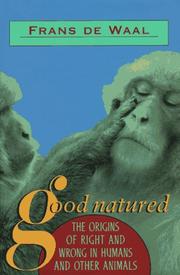
Waal shows how ethical behavior is as much a matter of evolution as any other trait.
2001
433 pages
Science & Nature
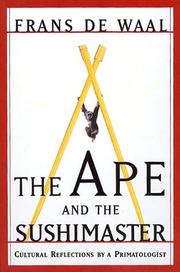
"The Ape and the Sushi Master challenges our most basic assumptions about who we are and how we differ from other animals. In a delightful mix of autobiographical anecdote, rigorous research, and speculation, eminent primatologist Frans de Waal leads us to consider the possibility that …
2001
320 pages
Science & Nature
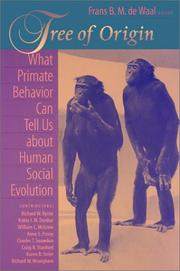
How did we become the linguistic, cultured, and successful apes we are? Our closest relatives offer tantalizing clues. In this volume top primate experts read these clues and compose an extensive picture of what the behaviour of monkeys and apes can tellus about our own …
1989
294 pages
Examines how simians cope with aggression, and how they make peace after fights.
2014
270 pages
Philosophy & ReligionPsychology & Self-Help
Morality is often defined in opposition to the natural "instincts," or as a tool to keep those instincts in check. New findings in neuroscience, social psychology, animal behaviour, and anthropology have brought us back to the original Darwinian position that moral behaviour is continuous with …
2000
409 pages
Aggression and competition are customarily presented as the natural state of affairs in both human society and the animal kingdom. Yet, as this book shows, our species relies heavily on cooperation for survival as do many others -- from wolves and dolphins to monkeys and …