Fredric Jameson
1934–2024
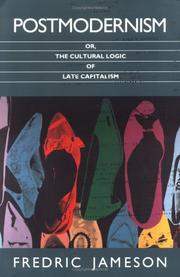
Fredric Ruff Jameson was an American literary critic, philosopher and Marxist political theorist. He was best known for his analysis of contemporary cultural trends, particularly his analysis of postmodernity and capitalism. Jameson's best-known books include Postmodernism, or, The Cultural Logic of Late Capitalism (1991) and The Political Unconscious (1981).
From Wikipedia · CC BY-SA 4.0
35 books in our catalogue.
1989
350 pages
History
"In this second edition of The Repeating Island, Antonio Benítez-Rojo, a master of the historical novel, short story, and critical essay, continues to confront the legacy and myths of colonialism. This co-winner of the 1993 MLA Katherine Singer Kovacs Prize has been expanded to include …
Standalone books
1990
438 pages
This wide-ranging work seeks to crystallize a definition of postmodernism. The author looks at the postmodern across a wide landscape, from high art to low; from market ideology to architecture, from painting to punk; film, from video art to literature.
2005
496 pages
Science Fiction
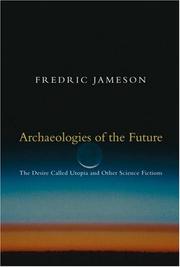
"In an age of globalization characterized by the dizzying technologies of the First World, and the social disintegration of the Third, is the concept of utopia still meaningful? Archaeologies of the Future, Jameson's most substantial work since Postmodernism, Or, the Cultural Logic of Late Capitalism, …
2005
339 pages
A major literary event, the publication of this masterly translation makes one of the towering works of twentieth-century German literature available to English-speaking readers for the first time. Spanning the period from the late 1930s to World War II, this historical novel dramatizes anti-fascist resistance …
1981
320 pages
General Fiction
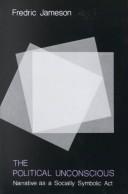
The Political Unconscious: Narrative as a Socially Symbolic Act is a 1981 book by the Marxist literary theorist Fredric Jameson. Often cited as a powerful overview and methodological guide, it is the work with which Jameson made his greatest impact. The book has been the …
1992
222 pages
Art & Photography
2007
270 pages
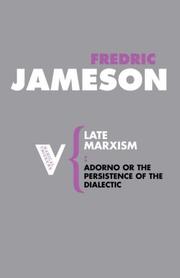
In the name of an assault on "totalization" and "identity," a number of contemporary theorists have been busily washing Marxism's dialectical and utopian projects down the plug-hole of postmodernism and "post-politics." A case in point is recent interpretation of one of the greatest twentieth-century philosophers, …
2002
250 pages
Philosophy & Religion
"The concepts of modernity and modernism are amongst the most controversial and vigorously debated in contemporary philosophy and cultural theory. In this new, muscular, intervention Fredric Jameson -- erhaps the most influential and persuasive theorist of postmodernity -- explores these notions in a fresh and …
1962
179 pages
Provides a key to evaluation and appreciation of Jean-Paul Sartre's writings and of the basic precepts of Existentialism.
2010
136 pages
"Fredric Jameson is America's leading Marxist critic. A prodigiously energetic thinker whose writings sweep majestically from Sophocles to science fiction."--Terry Eagleton. "Probably the most important cultural critic writing in English today ... It can be truly said that nothing cultural is alien to him."--Colin MacCabe. …
2000
408 pages
"Fredric Jameson is one of the most provocative and influential cultural critics of our age. Analyzing and historicizing cultural phenomena, he weaves together some of the most powerful critical paradigms, including Marxism, psychoanalysis, and poststructuralism, into an original and systematic vision of the contemporary world." …
1972
230 pages
Language & Reference
An analysis of Keats' poetry that traces his intellectual development against a backdrop of eighteenth- and nineteenth-century thought.
2019
384 pages
"This major new work by Fredric Jameson is not a book about 'method,' but it does propose a dialectic capable of holding together in one breath the heterogeneities that reflect our biological individualities, our submersion in collective history and class struggle, and our alienation to …
2003
434 pages
Philosophy & ReligionPolitics & Society
1961
257 pages
Language & Reference
1990
360 pages
Art & Photography
2015
328 pages
High modernism is now as far from us as antiquity was for the Renaissance. Such is the premise of Fredric Jameson’s major new work in which modernist works, this time in painting (Rubens) and music (Wagner and Mahler), are pitted against late-modernist ones (in film) …
1994
225 pages
Long considered the foremost American Marxist theorist, Fredric Jameson continues his investigation of postmodernism under late capitalism in The Seeds of Time. In three parts Jameson presents the problem of Utopia, attempting to diagnose the cultural present and to open a perspective on the future …
1999
274 pages
Philosophy & ReligionPolitics & Society
2020
288 pages
Philosophy & Religion
"A comprehensive new reading of Walter Benjamin's major works, as well as a great number of his less well-known publications, from one of America's foremost cultural and literary critics"--
2007
312 pages
Philosophy & Religion
2001
172 pages
Business & EconomicsPolitics & Society
2011
158 pages
Business & Economics
Representing Capital, Fredric Jamesonʹs first book-length engagement with Marxʹs magnum opus, is a unique work of scholarship that records the progression of Marxʹs thought as if it were a musical score. The textual landscape that emerges is the setting for paradoxes and contradictions that struggle …
2013
432 pages
General Fiction
"The Antinomies of Realism is a history of the nineteenth-century realist novel and its legacy told without a glimmer of nostalgia for artistic achievements that the movement of history makes it impossible to recreate. The works of Zola, Tolstoy, Pérez Galdós, and George Eliot are …
2009
490 pages
Business & EconomicsPolitics & Society
2010
625 pages
Philosophy & Religion
"After half a century exploring dialectical thought, renowned cultural critic Fredric Jameson presents a comprehensive study of a misunderstood yet vital strain in Western philosophy. The dialectic, the concept of the evolution of an idea through conflicts arising from its inherent contradictions, transformed two centuries …