Omer Bartov is an Israeli-American historian. He is the Dean's Professor of Holocaust and Genocide Studies at Brown University, where he has taught since 2000. Bartov is a historian of the Holocaust and is considered a leading authority on genocide.
From Wikipedia · CC BY-SA 4.0
12 books in our catalogue.
1991
238 pages
History
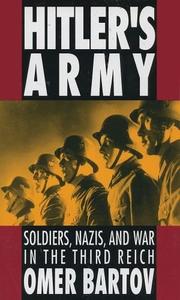
In Hitler's Army, Omer Bartov successfully challenges the prevailing view that the German Army of World War II was an apolitical, professional fighting force, having little to do with the Nazi Party. Bartov focuses on the titanic struggle between Germany and the Soviet Union -- …
1983
216 pages
History
xxvi, 218 p. : 21 cm
2000
307 pages
History
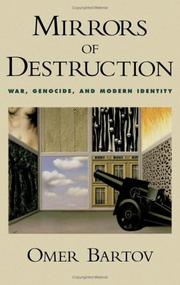
"Mirrors of Destruction examines the relationship between total war, state-organized genocide, and the emergence of modern identity. Here, Omer Bartov demonstrates that in the twentieth century there have been intimate links between military conflict, mass murder of civilian populations, and the definition and categorization of …
1999
312 pages
HistoryPolitics & Society
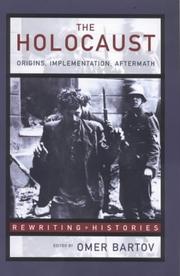
Holocaust: Origins, Implementation, Aftermath presents a critical and important study of the holocaust. Complete with an introduction that summarises the state of the field, this book contains major reinterpretations by leading holocaust authors along with key texts on testimony, memory, and justice after the catastrophe.The …
2018
407 pages
HistoryPolitics & Society
"A fascinating and cautionary examination of how genocide can take root at the local level--turning neighbors, friends, and even family members against one another--as seen through the eastern European border town of Buczacz during World War II." -- Amazon.com.
2007
256 pages
HistoryPolitics & Society
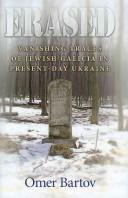
In Erased , Omer Bartov uncovers the rapidly disappearing vestiges of the Jews of western Ukraine, who were rounded up and murdered by the Nazis during World War II with help from the local populace. What begins as a deeply personal chronicle of the Holocaust …
1996
251 pages
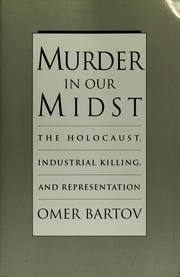
Murder in Our Midst: The Holocaust, Industrial Killing, and Representation examines the emergence, implementation, and representation of industrial killing, an inherent and crucial component of modernity whose most extreme manifestation was the Holocaust. The mechanized, impersonal, and sustained mass destruction of human beings, organized and …