Thinking
1978
258 pages
Philosophy & Religion
Includes chapters on Plato, Socrates, Thomas Aquinas, and Nietzsche.
Includes chapters on Plato, Socrates, Thomas Aquinas, and Nietzsche.
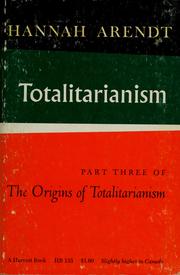
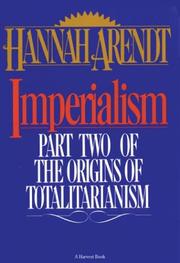
Hannah Arendt's definitive work on totalitarianism and an essential component of any study of twentieth-century political history The Origins of Totalitarianism begins with the rise of anti-Semitism in central and western Europe in the 1800s and continues with an examination of European colonial imperialism from …
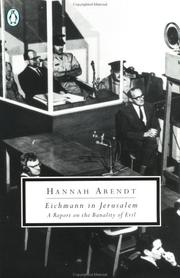
Eichmann in Jerusalem: A Report on the Banality of Evil is a 1963 book by political theorist Hannah Arendt. Arendt, a Jew who fled Germany during Adolf Hitler's rise to power, reported on Adolf Eichmann's trial for The New Yorker. A revised and enlarged edition …
A work of striking originality bursting with unexpected insights, The Human condition is in many respects more relevant now than when it first appeared in 1958. In her study of the state of modern humanity, Hannah Arendt considers humankind from the perspective of the actions …
El término «violencia», en su sentido más elemental, refiere al daño ejercido sobre las personas por parte de otros seres humanos. Los experimentos totalitarios del siglo xx ampliaron este uso de la violencia, a una escala y una intensidad inéditas en la historia de la …
Essays examining the effect on political and social thought of the western world's break with the Graeco-Roman tradition.
Collection of essays which present portraits of individuals ranging from Rosa Luxemburg to Pope John XXIII who the author believes have illuminated "dark times" "Dark times" is Brecht's phrase, and Hannah Arendt uses it not to suggest that those she writes about are "mouthpieces of …
"She was a Jew born in Germany in the early twentieth century, and she studied with the greatest German minds of her day - Martin Heidegger and Karl Jaspers among them. After the rise of the Nazis, she emigrated to America, where she proceeded to …
Un libro que llamara profundamente la atencion de cuantos se interesen por los problemas politicos actuales; inicia con una reflexion sobre los documentos del Pentagono, originario de una grave crisis de confianza de los norteamericanos respecto a sus gobernantes y, en general, enfoca aspectos y …
They first met in New York: Mary McCarthy, an American writer, and Hannah Arendt, a philosopher who had fled Nazi Germany. They soon became friends and began a remarkable twenty-five-year exchange. McCarthy was an ardent, if not irrepressible, correspondent, whose letters served her autobiographical impulse …
The life of a Jewish intellectual and romantic, in Germany, 1771-1833.
Few thinkers have tackled the political horrors and complexities of this century with the insight and passionate intellectual integrity of Hannah Arendt. A philosophic champion of human freedom, she was among the first to draw the now-evident parallel between Nazism and Bolshevism and to identify …
Hannah Arendt's last philosophical work was an intended three-part project entitled 'The Life of the Mind'. Unfortunately, Arendt lived to complete only the first two parts, 'Thinking' and 'Willing'. Of the third, 'Judging', only the title page, with epigraphs from Cato and Goethe, was found …
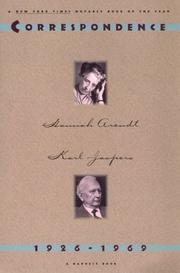
"The correspondence between Hannah Arendt and Karl Jaspers begins in 1926, when the twenty-year-old Arendt studied philosophy with Jaspers in Heidelberg. It is interrupted by Arendt's emigration and Jaspers's "inner emigration," and it is resumed immediately after World War II. The initial teacher-student relationship develops …
Hannah Arendt began her scholarly career with an exploration of Saint Augustine's concept of caritas, or neighborly love, written under the direction of Karl Jaspers and the influence of Martin Heidegger. After her German academic life came to a halt in 1933, Arendt carried her …
$$Les origines du totalitarisme$$, ouvrage paru en trois volumes en français chez trois éditeurs différents, réunis ici en un seul volume comme dans l'édition américaine, constitue le coeur de l'oeuvre de Hannah Arendt. Le texte est accompagné d'un dossier critique, d'oeuvres complémentaires et de correspondances.
"After the publication of The Origins of Totalitarianism in 1951, Hannah Arendt undertook an investigation of Marxism, a subject that she had deliberately left out of her earlier work. Her inquiry into Marx's philosophy led her to a critical examination of the entire tradition of …
"A unique selection of the most significant interviews given by Hannah Arendt, including the last she gave before her death in 1975. Some are published here in English for the first time. Arendt was one of the most important thinkers of her time, famous for …
Recognized on publication as the definitive account of its subject, [The Origins of Totalitarianism](/works/OL10460640W) remains the foundation for continuing discussion. In this first volume of her monumental study Dr. Arendt traces the rise of antisemitism in Central and Western European Jewish history in the nineteenth …
Spätestens durch ihre Berichterstattung vom Prozess gegen Adolf Eichmann und ihr Buch „Eichmann in Jerusalem“ wurde sie weltbekannt. Doch schon die junge Hannah Arendt war in ihrem politischen Denken und Handeln eine herausragende Persönlichkeit. Ihre Beiträge für den „Aufbau“, die in New York publizierte Zeitung …