Mathesis (Paris, France)

Standalone books


Sogenannte Monadologie und Principes de la nature et de la grace fondés en raison
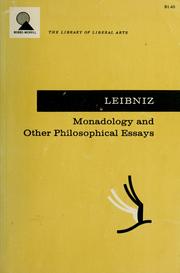
The Monadology is one of Gottfried Leibniz's best known works of his later philosophy. It is a short text which presents, in some 90 paragraphs, a metaphysics of simple substances, or monads.

Theodicy
"In order to be truly free, must you act arbitrarily? If an event did not happen, could it have happened? Since there is evil, and God could have made the world without evil, did God fail to pick the best course? Grappling with such simple£yet …






Discours de métaphysique
The Discourse on Metaphysics is a short treatise by Gottfried Wilhelm Leibniz in which he develops a philosophy concerning physical substance, motion and resistance of bodies, and God's role within the universe. It is one of the few texts presenting in a consistent form the …



Monadología
La Monadología es la obra madura de Leibniz (1646-1716), en la cual queda expuesta, en brevísimas síntesis, su concepción global del universo, la concepción de uno de los más geniales pensadores de todos los tiempos. En la Monadología resuenan todos los motivos que Leibniz ha …

New essays on human understanding
Leibniz argues chapter by chapter with John Locke's Essay Concerning Human Understanding, challenging his views about knowledge, personal identity, God, morality, mind and matter, nature versus nurture, logic and language, and a host of other topics. --From publisher description.
Protogaea
Protogaea, an ambitious account of terrestrial history, was central to the development of the earth sciences in the eighteenth century and provides key philosophical insights into the unity of Gottfried Wilhelm Leibniz’s thought and writings. In the book, Leibniz offers observations about the formation of …