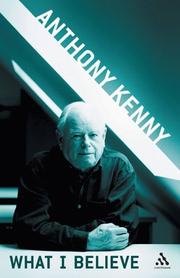
Sir Anthony John Patrick Kenny was a British philosopher whose interests lay in the philosophy of mind, ancient and scholastic philosophy, the philosophy of religion, and the philosophy of Wittgenstein of whose literary estate he was an executor. With Peter Geach, he made a significant contribution to analytical Thomism, a movement whose aim is to present the thought of St. Thomas Aquinas in the style of analytic philosophy. He was a president of the British Academy and the Royal Institute of Philosophy.
From Wikipedia · CC BY-SA 4.0
37 books in our catalogue.
Standalone books
2007
1266 pages
HistoryPhilosophy & Religion
xvii, 1058 p. ; 24 cm
1998
365 pages
HistoryPhilosophy & Religion
2000
457 pages
HistoryPhilosophy & Religion
1969
86 pages
Biography & MemoirPhilosophy & Religion
2009
1272 pages
HistoryPhilosophy & Religion
2006
400 pages
HistoryPhilosophy & Religion
1993
182 pages
HistoryPhilosophy & Religion
Aquinas' mature works, though theological in intent, contain much material which is philosophical in the sense that it is not in any way dependent on beliefs which are specifically Christian. His philosophical psychology, or philosophy of mind, was not taken seriously by secular thinkers, with …
2001
424 pages
HistoryPhilosophy & Religion
1973
240 pages
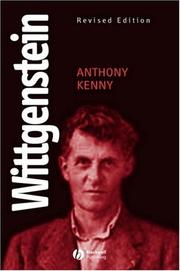
An overview of the philosophy of Ludwig Wittgenstein.
1963
245 pages
Philosophy & Religion
Action, Emotion and Will was first published in 1963, when it was one of the first books to provoke serious interest in the emotions and philosophy of human action. Almost forty years on, Anthony Kenny's account of action and emotion is still essential reading for …
1983
111 pages
Biography & MemoirHistory
"Sir Thomas More (/mr/; 7 February 1478 ? 6 July 1535), known to Roman Catholics as Saint Thomas More since 1935, was an English lawyer, social philosopher, author, statesman, and noted Renaissance humanist. He was an important councillor to Henry VIII of England and was …
1985
115 pages
Biography & MemoirPhilosophy & Religion
John Wyclif, who lived from the late twenties to the early eighties of the fourteenth century, was long ago given the title "The Morning Star of the Reformation." Protestants have admired him for his attacks on the wealth and corruption of the medieval Church and …
1985
214 pages
Biography & MemoirPhilosophy & Religion
1980
94 pages
Biography & Memoir
2000
121 pages
Inleiding tot leven en werk van de middeleeuwse filosoof (1225-1274).
1979
181 pages
Philosophy & Religion
1983
94 pages
Philosophy & Religion
1995
222 pages
Although almost unknown in his lifetime, it was Gottlob Frege (1848-1925) who set the agenda for much of twentieth-century philosophy. His 'concept script' overthrew Aristotle's long-established system of logic and underlies all subsequent developments in the subject. His radically new approach to the foundations of …
1987
182 pages
Philosophy & Religion
1978
250 pages
Philosophy & Religion
1987
179 pages
HistoryPhilosophy & Religion
1985
137 pages
Philosophy & ReligionPolitics & Society
1989
193 pages
Philosophy & ReligionPsychology & Self-Help
1990
350 pages
Philosophy & Religion
1994
274 pages
Philosophy & Religion
2006
179 pages
Philosophy & Religion
1992
125 pages
Philosophy & Religion