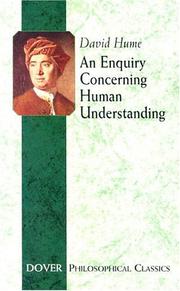
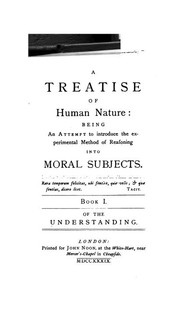
David Hume was a Scottish philosopher, historian, economist and essayist who is known for his highly influential system of empiricism, philosophical scepticism and metaphysical naturalism. Beginning with A Treatise of Human Nature (1739–40), Hume strove to create a naturalistic science of man that examined the psychological basis of human nature.
From Wikipedia · CC BY-SA 4.0
65 books in our catalogue.
1900
205 pages
Philosophy & ReligionPolitics & Society
"Over a series of elegantly written, engaging essays, the Enquiry examines the experiential and psychological sources of meaning and knowledge, the foundations of reasoning about matters that lie beyond the scope of our sensory experience and memory, the nature of belief, and the limitations of …
1779
114 pages
HistoryPhilosophy & Religion
Dialogues Concerning Natural Religion is a philosophical work by the Scottish philosopher David Hume. Through dialogue, three fictional characters named Demea, Philo, and Cleanthes debate the nature of God's existence. While all three agree that a god exists, they differ sharply in opinion on God's …
1739
678 pages
Philosophy & Religion
The eighteenth-century Scottish philosopher's classic work on human understanding and morals.
2015
320 pages
Philosophy & Religion
1754
582 pages
History
History of England published in 1818. In 8 volumes. It is a re-writing of an earlier version with a short autobiography in the first volume written in 1776, dated 18th April. Adam Smith also had a letter in the preface written to William Strathern dated …
1751
169 pages
Philosophy & ReligionPsychology & Self-Help
1875
616 pages
Business & EconomicsPhilosophy & ReligionPolitics & Society
1758
516 pages
Philosophy & ReligionPolitics & Society
1969
383 pages
Philosophy & Religion
David Hume (1711-76) is the most important philosopher ever to have written in English. Although best known for his contributions to epistemology, metaphysics, and the philosophy of religion, Hume also made substantial and influential contributions to psychology and the philosophy of mind, ethics, the philosophy …
1998
125 pages
Philosophy & ReligionPsychology & Self-Help
1965
339 pages
Philosophy & Religion
1948
388 pages
Philosophy & ReligionPolitics & Society
1759
76 pages
HistoryPhilosophy & Religion
As every enquiry, which regards religion, is of the utmost importance, there are two questions in particular, which challenge our attention, to wit, that concerning its foundation in reason, and that concerning its origin in human nature. Happily, the first question, which is the most …
1826
16 pages
Philosophy & Religion
1955
224 pages
Business & Economics
1957
Philosophy & Religion
1953
166 pages
Politics & Society
1993
237 pages
Philosophy & Religion
"David Hume is the greatest and also one of the most provocative philosophers to have written in the English language. His sceptical accounts of the causes and consequences of religious belief are expressed most powerfully in the Dialogues Concerning Natural Religion and The Natural History …
1757
240 pages
Philosophy & Religion
1952
509 pages
Fantasy
Ptolemy, Copernicus, Kepler--Great Books.
1965
339 pages
Philosophy & Religion
1906
257 pages
Business & EconomicsPolitics & Society
2017
Philosophy & Religion
1991
Philosophy & Religion
2004
404 pages
Philosophy & Religion
1964
183 pages
Philosophy & Religion
1826
Philosophy & Religion
1826
Philosophy & Religion
2006
HistoryPhilosophy & Religion
1907
267 pages
Philosophy & Religion
2007
264 pages
Philosophy & Religion
2015
460 pages
Philosophy & ReligionPolitics & Society
1975
417 pages
Philosophy & Religion
1767
Philosophy & Religion
1900
410 pages
Philosophy & ReligionPolitics & Society
1870
589 pages
Philosophy & ReligionPolitics & Society
1766
127 pages
Philosophy & Religion
1997
96 pages
Philosophy & Religion
The passages are all taken from the Treatise of human nature, except for the last one, which comes from the Enquiry concerning human understanding.
2007
267 pages
Philosophy & Religion
1817
616 pages
Philosophy & Religion
1998
237 pages
Philosophy & Religion
1964
522 pages
Philosophy & Religion
2011
860 pages
Philosophy & Religion
1854
Philosophy & Religion
2018
342 pages
Philosophy & Religion
1777
Philosophy & Religion
Book digitized by Google from the library of Oxford University and uploaded to the Internet Archive by user tpb.
1759
Philosophy & Religion
1759
280 pages
Philosophy & Religion
1992
304 pages
Philosophy & Religion