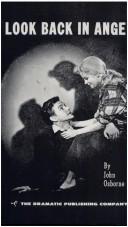
John James Osborne was an English playwright, screenwriter, actor, and entrepreneur, who is regarded as one of the most influential figures in post-war theatre. Born in London, he briefly worked as a journalist before starting out in theatre as a stage manager and actor. He lived in poverty for several years before his third produced play, Look Back in Anger (1956), brought him national fame.
From Wikipedia · CC BY-SA 4.0
54 books in our catalogue.
1957
96 pages
Biography & MemoirChildren'sPoetry & Drama
Osborne led the surge of the 'angry young men' with this play about a disaffected young man railing against what he sees as the sterility of middle class married life in post-war Britain.
1957
89 pages
Poetry & Drama
1961
102 pages
Poetry & Drama
A portrait of the passionate priest, the rebel who challenged and changed the spiritual world of his time.
1981
285 pages
Biography & Memoir
1960
286 pages
Poetry & Drama
1996
375 pages
Poetry & Drama
1964
192 pages
Poetry & Drama
2008
240 pages
HistoryPoetry & Drama
"Written in an outspoken, polemical style, this volume combines a devastating critique of the theoretical flimsiness of most Larkin scholarship with a revolutionary interpretation of the poems that grants them a central role in the emergence of a British Postmodernism and accounts for their continuing …
1963
136 pages
Poetry & Drama
1971
185 pages
Poetry & Drama
2009
355 pages
Biography & MemoirTravel
1991
283 pages
Biography & Memoir
1973
78 pages
HistoryPoetry & Drama
1973
60 pages
Poetry & Drama
2009
191 pages
HistoryPoetry & Drama
1991
104 pages
Poetry & Drama
2000
216 pages
Poetry & Drama
"From her college days onward, Dawn Powell, known primarily for her novels and her diaries and letters, dreamed of becoming a successful playwright. Indeed, over the course of four decades, she finished at least ten plays and was working on fashioning her novel, The Golden …
1965
115 pages
Poetry & Drama
1998
296 pages
Poetry & Drama
1999
592 pages
Biography & Memoir
2014
214 pages
Art curator Hans Ulrich Obrist, from his own experiences and inspirations - from the organization of his first exhibition in a small kitchen in Zurich at the age of 23, to the meetings and conversations with artists, curators and thinkers dedicated - seeks with the …
2009
289 pages
Politics & Society
The hilarious and revealing account of the author's month as a radio head: listening to a different radio station each day, all day, for 30 days.
2020
348 pages
HistoryPhilosophy & ReligionTravel
"This book addresses a critical era in the history of the city of Rome, the eighth century CE. This was the moment when the bishops of Rome assumed political and administrative responsibility for the city's infrastructure and the physical welfare of its inhabitants, in the …
1975
79 pages
Poetry & Drama
1972
36 pages
Poetry & Drama
1999
102 pages
Poetry & Drama
1975
57 pages
Poetry & Drama
1971
143 pages
Poetry & Drama
1973
311 pages
Poetry & Drama
Selected dramatic works reveal the modern playwright's concern about human nature, oppression, and weakness.