William Poundstone is an American author, columnist, and skeptic. He has written a number of books including the Big Secrets series and a biography of Carl Sagan.
From Wikipedia · CC BY-SA 4.0
25 books in our catalogue.
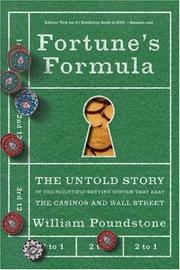
2005
400 pages
Business & EconomicsHistoryScience & Nature
This book is about Kelly's criterion developed in 1956 by two scientists (John Kelly Jr. and Claude Shannon) at Bell Labs for the transmission of information over copper wires but who immediately realized its application to gaming and investing. Many more professional gamblers used the …
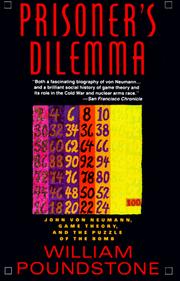
1992
290 pages
Biography & MemoirHistoryScience & Nature
Watching players bluff in a poker game inspired John von Neumann--father of the modern computer and one of the sharpest minds of the century--to construct game theory, a mathematical study of conflict and deception. Game theory was embraced at the RAND Corporation, the think tank …
1999
473 pages
Biography & Memoir
1983
267 pages
Politics & Society
1984
252 pages
Science & Nature
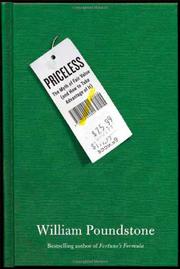
2009
336 pages
Examines how "price consultants" and retailers convince consumers to pay more for less, and how negotiation coaches offer similar advice for businesspeople cutting deals Prices are a collective hallucination. Here, author William Poundstone reveals the hidden psychology of value. In psychological experiments, people are unable …
1988
274 pages
Philosophy & ReligionScience & Nature
2012
300 pages
Are You Smart Enough to Work at Google? is a 2012 business book by Pulitzer Prize-nominated science writer, William Poundstone, describing details of the methods used and questions asked of job applicants to Google.
1986
244 pages
HistoryPolitics & Society
2003
282 pages
For years, Microsoft and other high-tech companies have been posing riddles and logic puzzles like these in their notoriously grueling job interviews. Now "puzzle interviews" have become a hot new trend in hiring. From Wall Street to Silicon Valley, employers are using tough and tricky …
2014
284 pages
Psychology & Self-Help
We are hard-wired to believe that the world is more predictable than it is. We chase 'winning streaks' that are often just illusions, and we are all too predictable exactly when we try hardest not to be. In the 1970s, Daniel Kahneman and Amos Tversky …
1993
272 pages
HistoryPolitics & Society
Includes how to escape a straightjacket, backword messages on albums, secret identities and magic tricks.
2014
311 pages
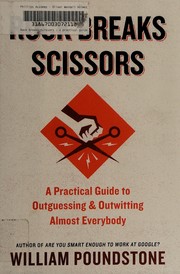
"Rock breaks scissors is based on a simple principle: people are unable to act randomly. Instead they display unconscious patterns that the savvy person can outguess. The principle applies to friends playing rock, paper, scissors for a bar tab as well as to the crowds …
2016
340 pages
Looks at the state of knowledge in the American public, and demonstrates how many areas of knowledge correlate with quality of life, politics, and behavior, arguing that being knowledgeable has significant value even when facts can be looked up with little effort.
1985
HistoryPolitics & Society
2019
313 pages
How to think about the unthinkable using cock-eyed statistics and pie-eyed philosophy.
2008
352 pages
Politics & Society