Bovine Infection Abortion
1924
372 pages
Philosophy & Religion
Clearly not the work it was originally marked to be.
Clearly not the work it was originally marked to be.
The theological method of St. Thomas Aquinas considered as the cornerstone of Christian philosophy, by a contemporary French Roman Catholic philosopher.
English equivalent of Introduction a l'etude de saint Augustin, 2 ed., Paris, Vrin 1943.
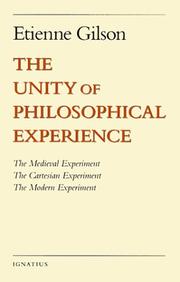
The best summary of this book is in the author's foreword: "It is the proper aim and scope of the present book to show that the history of philosophy makes philosophical sense, and to define its meaning in regard to the nature of philosophical knowledge …
All these lectures converge to this conclusion: that the Middle Ages produced, besides a Christian literature and a Christian art as everyone admits, this very Christian philosophy which is a matter of dispute. No one, of course, maintains that this mediaeval philosophy was created out …
The study of being was one of the main preoccupations of Gilson's scholarly and intellectual life. Being and Some Philosophers is at once a testament to the persistence of these concerns and an important landmark in the history of the question of being. The book …
"Etienne Gilson addresses the idea that "art is the making of beauty for beauty's own sake." By distinguishing between aesthetics, which promotes art as a form of knowledge, and philosophy, which focuses on the presence of the artist's own talent or genius, Gilson maintains that …
In this well-known work, Etienne Gilson undertakes a sufficiently difficult task, namely, to define the spirit of mediaeval philosophy. He focuses on and supports his conclusion that the Middle Ages produced, besides a Christian literature and art as everyone admits, this very Christian philosophy, which …
The Aristotelian Society of Marquette University each year invites a scholar to speak on the Philosophy of St. Thomas Aquinas. Those lectures have come to be called the Aquinas Lectures and are customarily delivered on the Sunday nearest March 7, the feast day of the …
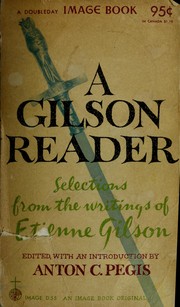
Etienne Gilson, French historian and philosopher, was born in 1884. Member of the French Academy and Director of the Institute of Medieval Studies at Toronto, he is the author of, among many brilliant works, The Spirit of Medieval Philosophy and The Unity of Philosophical Experience.
All these lectures converge to this conclusion: that the Middle Ages produced, besides a Christian literature and a Christian art as everyone admits, this very Christian philosophy which is a matter of dispute. No one, of course, maintains that this mediaeval philosophy was created out …