Benedictus de Spinoza
1632–1677
Baruch (de) Spinoza, also known under his Latinized pen name Benedictus de Spinoza, was a philosopher of Portuguese-Jewish origin who was born and lived in the Dutch Republic. A forerunner of the Enlightenment, Spinoza significantly influenced modern biblical criticism, 17th-century rationalism, and Dutch intellectual culture, establishing himself as one of the most important and radical philosophers of the early modern period. Influenced by Stoicism, Thomas Hobbes, René Descartes, and heterodox Christians, Spinoza was a leading philosopher of the Dutch Golden Age.
From Wikipedia · CC BY-SA 4.0
51 books in our catalogue.
1895
114 pages
Philosophy & ReligionScience & Nature
Tractatus de Intellectus Emendatione is an unfinished work of philosophy by the seventeenth-century philosopher Baruch Spinoza, published posthumously in 1677.
1968
246 pages
Philosophy & ReligionPolitics & Society
Standalone books
1883
272 pages
Philosophy & Religion
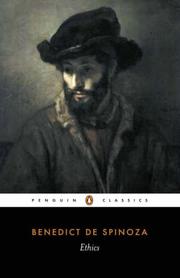
Ethics is a philosophical book written by Benedictus de Spinoza. Although published after Spinoza's death, in 1677, it is considered his greatest and most famous work. In it, Spinoza tries to set out a "fully cohesive philosophical system that strives to provide a coherent picture …
2005
208 pages
Philosophy & Religion
Ethics, Demonstrated in Geometrical Order is a philosophical treatise written in Latin by Baruch Spinoza. It was written between 1661 and 1675 and was first published posthumously in 1677.
1670
359 pages
Philosophy & ReligionPolitics & Society
"This new edition of Samuel Shirley's translation of the Theological-Political Treatise - a revision of that published by E. J. Brill in 1991, based on Gebhart's Heidelberg edition of 1925 - is accompanied by a new Introduction and Notes prepared especially for this volume by …
1883
162 pages
Philosophy & Religion
"One of the most original and penetrating philosophers of all time, Spinoza is also one of the clearest and easiest to understand if read as a whole. This unabridged reprint of the famous Bohn edition contains all his most important works and a generous selection …
1992
297 pages
Philosophy & Religion
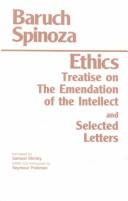
Since their publication in 1982, Samuel Shirley's translations of Spinoza's Ethics and Selected Letters have been commended for their accuracy and readability. Now with the addition of his new translation of Treatise on the Emendation of the Intellect this enlarged edition will be even more …
1984
296 pages
Philosophy & Religion
2001
267 pages
Politics & Society
1982
262 pages
Philosophy & Religion
I. By that which is self-caused, I mean that of which the essence involves existence, or that of which the nature is only conceivable as existent.
1905
177 pages
Philosophy & Religion
1887
21 pages
Philosophy & Religion
1930
394 pages
Language & ReferencePhilosophy & Religion
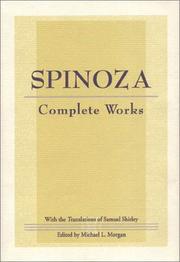
"The only complete edition in English of Baruch Spinoza's works, this volume features Samuel Shirley's preeminent translations, distinguished at once by the lucidity and fluency with which they convey the flavor and meaning of Spinoza's original texts.". "Michael L. Morgan provides a general introduction that …
1928
502 pages
Biography & Memoir
1949
294 pages
Philosophy & Religion
1925
Philosophy & Religion
1994
280 pages
Philosophy & Religion
1970
332 pages
Philosophy & Religion
1994
398 pages
Philosophy & Religion
1985
752 pages
Philosophy & Religion
"The Collected Works of Spinoza provides, for the first time in English, a truly satisfactory edition of all of Spinoza's writings, with accurate and readable translations, based on the best critical editions of the original-language texts, done by a scholar who has published extensively on …
1923
272 pages
Philosophy & Religion
2007
448 pages
Philosophy & Religion
1977
409 pages
Philosophy & Religion
2006
132 pages
Philosophy & Religion
El intercambio epistolar entre Brauch de Spinoza y Willem van Blijenbergh -comisionista de cereales y teólogo calvinista- se inicia en el mes de diciembre de 1664 y finaliza abruptamente poco tiempo después. En la primera de sus misivas, Blijenbergh solicita a Spinoza que le despeje …
1802
Philosophy & Religion
1910
246 pages
Philosophy & Religion
1926
376 pages
Philosophy & Religion
1997
380 pages
Philosophy & Religion
The Tractatus Theologico-Politicus (TTP) or Theologico-Political Treatise, is a 1670 work of philosophy written in Latin by the Dutch philosopher Baruch Spinoza (1632–1677) and published anonymously. The book was one of the most important and controversial texts of the early modern period. Its aim was …
2020
176 pages
Philosophy & Religion
A Autêntica Editora apresenta a primeira tradução para o português desta obra clássica, que traz o Tratado de Baruch de Espinosa sobre Deus, o homem, o seu bem-estar e sua felicidade. Constituído de duas partes, seguidas de um apêndice, ela antecedeu Ética e é considerada …
1993
443 pages
Philosophy & Religion
1877
102 pages
Philosophy & ReligionPsychology & Self-Help
2005
Philosophy & Religion
1948
240 pages
Philosophy & Religion
1997
378 pages
Philosophy & Religion
2004
342 pages
Philosophy & Religion
1930
Philosophy & Religion
2006
48 pages
Philosophy & Religion
1933
427 pages
Philosophy & Religion
1965
92 pages
Language & ReferencePhilosophy & Religion
1951
309 pages
Language & ReferencePhilosophy & Religion
1958
121 pages
Philosophy & Religion
"Based on the text Spinoza's Short treatise on God, man and his well-being, translated by Dr. A. Wolf from the Dutch [version of the author's Tractatus de Deo et homine]"
2006
456 pages
Philosophy & Religion
1888
338 pages
Philosophy & Religion
1925
392 pages
Philosophy & Religion
1860
332 pages
Politics & Society
1993
374 pages
Philosophy & Religion
1991
Philosophy & Religion
2014
96 pages
Philosophy & Religion
1937
197 pages
Politics & Society