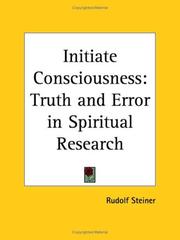
Christianity as mystical fact and the mysteries at antiquity. --
Book digitized by Google from the library of the New York Public Library and uploaded to the Internet Archive by user tpb.
Rudolf Joseph Lorenz Steiner was an Austrian New Age guru, philosopher, occultist, social reformer, architect, esotericist, and claimed clairvoyant and speaker with the dead. Steiner gained initial recognition at the end of the nineteenth century as a literary critic and published works including The Philosophy of Freedom. At the beginning of the twentieth century he founded an esoteric spiritual movement, anthroposophy, with roots in German idealist philosophy and theosophy. His teachings are influenced by (Christian) Gnosticism or neognosticism. Many of his ideas are pseudoscientific.
From Wikipedia · CC BY-SA 4.0
203 books in our catalogue.
Book digitized by Google from the library of the New York Public Library and uploaded to the Internet Archive by user tpb.
Austrian philosopher, playwright, and artist Rudolf Steiner (1861 1925) is perhaps best known as an educational philosopher and reformer, the founder of Steiner (or Waldorf) schools located around the world. These schools' philosophy represents the priorities Steiner discusses in Theosophy: the development of body, soul, …
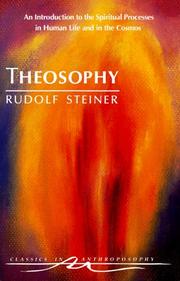
"As vital and relevant as when it was first published in 1910, this materpiece of esoteric, Rosicrucian cosmology (on which Rudolf Steiner worked and then reworked for many years, making it ever more precise and accurate) remains the most effective presentation to date of the …
Transcript of several lectures given by Rudolf Steiner.
Initiation brings into the realm of reason the purpose and into the realm of emotion the spirit of ones introduction into the Mysteries.
This is an essay in which Rudolf Steiner describes the hidden nature of the human being and the way an educator can work with these aspects to unfold the whole human being.
541 p., [8] leaves of plates : 21 cm
A NOTE ON THE TITLE AT first glance the title of this book may be somewhat misleading for the British reader. It may suggest to him associations with Anglo-Indian Theosophy and the Theosophical Society founded by H. P. Blavatsky. Rudolf Steiner, however, uses the term …
Published to commemorate the 50th anniversary of the Anthroposophic Society of America
Une introduction à la pédagogie de Steiner. Les écoles Waldorf qu'il a fondées en Allemagne en 1919 se sont répandues dans le monde entier. Les textes réunis ici offrent un aperçu général de cette pédagogie qui a profondément influencé les mouvements pour une éducation nouvelle.
Synopses of major themes developed by Rudolf Steiner. Richard Seddon, editor, combines, summarizes and references many of Steiner's works.
Returning from travels in war-torn Europe, Rudolf Steiner gives a stark impression of the disastrous conditions of the time, encouraging deeper esoteric work as a counter to the world-situation. Speaking under the broad theme of human development in the light of anthroposophy, he analyses the …
Samples of Steiner's work are to be found in this introductory reader in which Stephen E. Usher brings together excerpts from Steiner's many talks and writings on Social and political science. This volume also features an editorial introduction, commentary and notes. Topics include: psychological cognition; …
Spiritual teachings tell us that each “folk,” race, or ethnic group has a kind of over-soul that interacts with those people, lending them unique characteristics that affect the karma and destiny of tribes, races, and nations. Steiner explores the nature and activities of various folk …
The Philosophy of Freedom is the fundamental philosophical work of philosopher, Goethe scholar, and esotericist Rudolf Steiner (1861–1925). It addresses the question of whether and in what sense human beings are free. Originally published in 1894 in German as Die Philosophie der Freiheit, with a …