
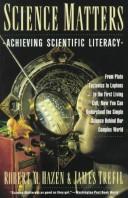
Science matters
Knowledge of the basic ideas and principles of science is fundamental to cultural literacy. But most books on science are often too obscure or too specialized to do the general reader much good.Science Matters is a rare exception-a science book for the general reader that …


Space atlas
"Filled with lavish illustrations, this book is a grand tour of the universe. Three ever widening domains are presented--the planets, the stars, and the large scale universe itself--each including the ones before it and extending outward"--
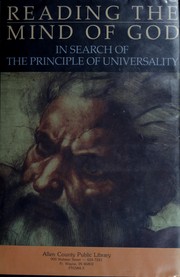

The sciences
Organized around a series of 24 scientific concepts (or great ideas), this book begins with the idea that the universe can be studied by observation and experiment. Encompasses physics, chemistry, astronomy, biology and earth sciences, focusing on general principles and their application to real-world situations …

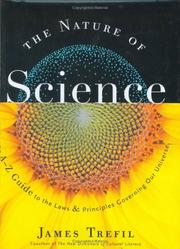
The Nature of Science
"Cloning, black holes, Fermat's last theorem, genetic drift, the inflationary universe, Newton's laws of motion, string theories. With lively writing and whimsical analogies, science popularizer James Trefil leads a remarkable A-Z tour through the discovery, significance, and workings of the universe's major laws. Here are …


Imagined Life
The captivating possibilities of extraterrestrial life on exoplanets, based on current scientific knowledge of existing worlds and forms of life It is now known that we live in a galaxy with more planets than stars. The Milky Way alone encompasses 30 trillion potential home planets. …


From atoms to quarks
Equips the general reader having only basic mathematical skills with an understanding of the evolution and present state of particle physics.


The moment of creation
Few questions grip the mind more forcefully than those about the creation of the universe, and since the discoveries of the 1920s it has been a primary goal of physicists to trace the history of the universe back to "where it all came from" the …

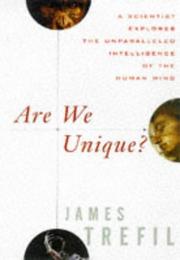


Space, time, infinity
Traces the history of astronomy, looks at what we have learned about the Sun, Moon, stars and planets, and identifies key questions which face astronomers of the future.


The Encyclopedia of Science and Technology
"Science is...wonderful and human: a complex web of ideas, facts, philosophical concepts, history, and serendipity. Destined to be the leader in the field, the Encyclopedia of Science and Technology is a full-color, A-to-Z guide that sets a new standard for science reference. Edited by acclaimed …

The story of innovation
Documenting the interconnectedness among the crucial milestones of our time, and illustrated with full-color photography, a comprehensive tour of modern science and technology explores the most important innovations and inventions in engineering, physics, medicine, chemistry, biology and more.


A scientist in the city
In his previous books, A Scientist at the Seashore and Meditations at Sunset, James Trefil used common place settings in the natural world as a point of departure for probing the mysteries of nature. In A SCIENTIST IN THE CITY, Trefil takes the opposite tack, …


Living in space
Discusses technological and human aspects of the colonization of space as it may be experienced by future generations.


The unexpected vista
Examines twelve questions exploring the way modern physicists view the world.

Why Science?
"Prize-winning scientist and bestselling author James Trefil explains why everyone needs to be "scientifically literate." As Trefil sees it, citizens simply cannot participate fully in the democratic process if they don't understand fundamental scientific concepts. And he describes exactly what these principles are, from understanding …