Robert I. Sutton is an American professor of management science at the Stanford University School of Engineering and a researcher in the field of evidence-based management. He is a New York Times best-selling author.
From Wikipedia · CC BY-SA 4.0
11 books in our catalogue.
2007
210 pages
Business & EconomicsPsychology & Self-Help
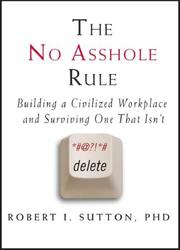
The No Asshole Rule is a New York Times, Wall Street Journal, USA Today and Business Week bestseller. It won a Quill Award for the top business book of 2007, and was recently chosen as one of audible.com's top picks as well.
2017
214 pages
Sutton starts with diagnosis: what kind of asshole problem, exactly, are you dealing with? From there, he provides field-tested, evidence-based, and sometimes surprising strategies for dealing with assholes-- avoiding them, outwitting them, disarming them, sending them packing, and developing protective psychological armor. By helping you …
2000
314 pages
Business & Economics
"The so-called knowledge advantage is a fallacy - even though companies pour billions of dollars into training programs, consultants, and executive education. The reason is not that knowledge isn't important. It's that most companies know, or can know, the same things. Moreover, even as companies …
2001
230 pages
Business & Economics
Introduces the proven rules that a company can use to promote innovation, arguing that the corporate world should hire misfits and encourage them to defy the existing culture and actively consider ideas that appear ridiculous or impractical.
2014
357 pages
Business & Economics
"In Scaling Up Excellence, bestselling author Bob Sutton and Stanford colleague Huggy Rao tackle the topic that obsesses businesses large and small, from start-ups to Fortune 500 companies--how to scale up their businesses and spread excellence throughout the organizational culture"--
2024
304 pages
Business & Economics
2011
265 pages
Business & EconomicsLanguage & Reference
Draws on real-life case studies and psychological research to explain what differentiates a good boss from a bad boss and explains what the best bosses do correctly.
2007
448 pages
Business & EconomicsLanguage & Reference
Argues that there is a need for evidence-based management to prevent leaders from relying on half-truths and nonsense derived from such conventional wisdom as "change or die," and "great leaders are in control of their companies."
2007
Business & Economics