Richard C. Lewontin
1929–2021
Richard Charles Lewontin was an American evolutionary biologist, mathematician, geneticist, and social commentator. A leader in developing the mathematical basis of population genetics and evolutionary theory, he applied techniques from molecular biology, such as gel electrophoresis, to questions of genetic variation and evolution. He was a self-described Marxist.
From Wikipedia · CC BY-SA 4.0
20 books in our catalogue.
1993
832 pages
Science & Nature
xxiii, 838 pages : 29 cm
1991
128 pages
Philosophy & ReligionPolitics & SocietyScience & Nature
"Geneticist Lewontin demonstrates how science (and scientists) is molded by society and how the dominant social and economic forces in society determine to a large extent what scientists do and how they do it"--Publisher description.
1995
193 pages
HistoryScience & Nature
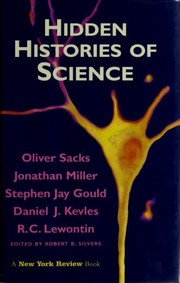
Essays by Oliver Sacks, Jonathan Miller, Stephen Jay Gould, Daniel J. Kevles, & R.C. Lewontin explore forgotten and neglected aspects of the history of science.
1976
612 pages
Science & Nature
THE TEXT BOOK IS ABT GENE MANIPULATIONS
1993
681 pages
Science & Nature
2000
144 pages
Science & Nature
One of our most brilliant evolutionary biologists, Richard Lewontin has also been a leading critic of those - scientists and non-scientists alike - who would misuse the science to which he has contributed so much. In this book, the author the scientist, and the critic …
1982
179 pages
The title relates how human beings differ from all others because of the interaction of genetic differences.
1939
440 pages
Science & Nature
2000
330 pages
Philosophy & ReligionScience & Nature
"In these essays from the New York Review of Books, several of which are here updated with new epilogues, Richard Lewontin demystifies some of the most controversial issues in the life sciences today. On topics ranging from Darwin to Dolly the sheep, including biological determinism, …
1984
322 pages
Politics & SocietyPsychology & Self-Help
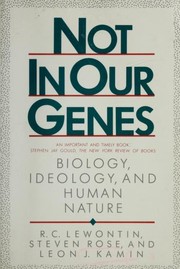
Not in Our Genes: Biology, Ideology and Human Nature is a 1984 book by the evolutionary geneticist Richard Lewontin, the neurobiologist Steven Rose, and the psychologist Leon Kamin, in which the authors criticize sociobiology and biological determinism and advocate a socialist society. They argue that …
1985
303 pages
Philosophy & ReligionPolitics & SocietyScience & Nature
Scientists act within a social context and from a philosophical perspective that is inherently political. Whether they realize it or not, scientists always choose sides. The Dialectical Biologist explores this political nature of scientific inquiry, advancing its argument within the framework of Marxist dialectic. These …
2007
304 pages
Science & Nature
Summary:How do we understand the world? While some look to the heavens for intelligent design, others argue that it is determined by information encoded in DNA. Science serves as an important activity for uncovering the processes and operations of nature, but it is also immersed …
1974
346 pages
Science & Nature
1971
193 pages
Science & Nature