
Standalone books
The social construction of reality
sociology book
Invitation to sociology
"This lucid and lively book, punctuated with witty, incisive examples, is addressed both to the layman who wants to know what sociology is all about -- and to students and sociologists who are concerned over the larger implications and dimensions of their discipline. The author …

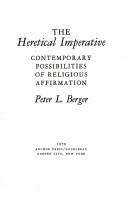
The heretical imperative
After ten years of writing in other areas, Peter L. Berger returns to the problem of religion and modernity discussed in his earlier book A Rumor of Angels. In The Heretical Imperative, however, not only is the argument developed further in terms of the challenge …
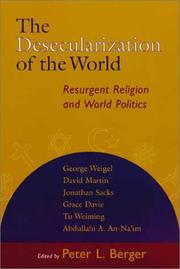
The desecularization of the world
"For Two Centuries theorists of "secularization" have been saying that religion must inevitably decline in the modern world. But much of the world today is as religious as ever. This volume challenges the belief that the modern world is increasingly secular, showing that while modernization …
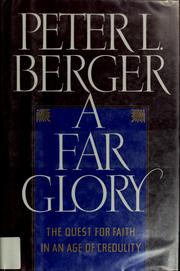




Certainty and doubt
Modernity was supposed to usher in a rational secular world where religion was marginalized. Some even predicted it would disappear. But religion has not only survived—it is growing and thriving in the modern world. Defying predictions, we live today in a world of plurality where …


Many globalizations
Much discussed but poorly understood, globalization is praised as the answer to all the world's problems and blamed for everything from pollution to poverty. In Many Globalizations, Peter Berger and Samuel Huntington bring together an array of scholars from around the world, who paint a …


New Sociology of Knowledge
"A classical sociologist can be defined as someone whose "works occupied a central position among the sociological ideas and notions of an era." Following this criterion, Michaela Pfadenhauer demonstrates the relevance of Peter L. Berger's work to the sociology of knowledge. Pfadenhauer shows that Berger …


Pyramids of Sacrifice ; political ethics and social change



The noise of solemn assemblies
Organized religion offers a symbolic integration of the varied elements of American society; it infuses political institutions with religious symbolism; and by way of personal adjustment it provides social adjustment and psychological integration. But these useful services to the establishment leave out the essence of …


Adventures of an accidental sociologist
Berger explains not only how he became a social scientist but also the many adventures that his calling led to. It focuses on the main intellectual issues that motivated his work and the various people and situations Berger has encountered.


Between relativism and fundamentalism
"Our contemporary culture is dominated by two extremes - relativism and fundamentalism. Neither is desirable: relativism claims that all questions of truth are irrelevant, whereas fundamentalism insists on sole possession of absolute truth. Internationally renowned sociologist of religion Peter Berger has gathered a group of …


Sociology
A textbook for introductory sociology courses in undergraduate colleges.


The limits of social cohesion
Normative conflicts center on fundamental disagreements over issues of public morality and the identity of a society. In thinking about normative conflicts on a global scale, two principal questions arise. First, are there common characteristics of such conflicts worldwide? Second, which institutions polarize such conflicts …

To empower people
Nearly twenty years ago in the first edition of this path-breaking book, Peter Berger and Richard John Neuhaus anticipated the major worldwide project of the 1990s: the renewal of civil society. They showed that such "mediating structures" as family, neighborhood, church, voluntary associations, and civic …