The Danube edition

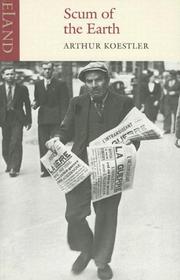
La lie de la terre
Memoirs covering period from the beginning of the present war until the fall of France.

Dialogue with death
"In 1937, while working for the London News Chronicle as a correspondent with the loyalist forces in the Spanish Civil War, I was captured by General Franco's troops and held for several months in solitary confinement, witnessing the executions of my fellow-prisoners and awaiting my …

Thieves in the night
Story of an English Jew who becomes deeply involved in the resettling of Palestine.

Arrow in the blue
An autobiography covering the first 26 years of the author's life.

The invisible writing
The Invisible Writing: The Second Volume Of An Autobiography, 1932-40 (1954) is a book by Arthur Koestler.
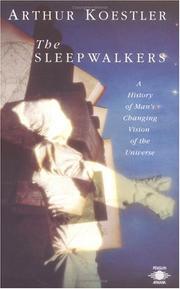
Sleep walkers
The Sleepwalkers: A History of Man's Changing Vision of the Universe is a 1959 book by Arthur Koestler. It traces the history of Western cosmology from ancient Mesopotamia to Isaac Newton. He suggests that discoveries in science arise through a process akin to sleepwalking. Not …

The act of creation
The Act of Creation is a 1964 book by Arthur Koestler. It is a study of the processes of discovery, invention, imagination and creativity in humour, science, and the arts. It lays out Koestler's attempt to develop an elaborate general theory of human creativity.
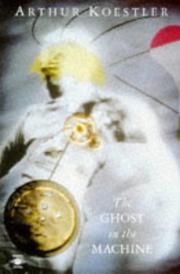
The ghost in the machine
The Ghost in the Machine is a work in philosophical psychology published in 1967. The title is a phrase coined by the Oxford philosopher Gilbert Ryle to describe the Cartesian dualist account of the mind–body relationship. Koestler shares with Ryle the view that the mind …

Standalone books
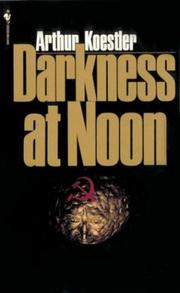
Sonnenfinsternis
Darkness at Noon (German: Sonnenfinsternis) is a novel by Hungarian-born British novelist Arthur Koestler, first published in 1940. His best known work, it is the tale of Rubashov, an Old Bolshevik who is arrested, imprisoned, and tried for treason against the government that he helped …

The thirteenth tribe
"The Khazars (Turkish: Hazarlar) were a semi-nomadic Turkic people who created one of the largest states of medieval Eurasia, Khazaria, with its capital at Atil. Astride one of the major arteries of commerce between northern Europe and southwestern Asia, Khazaria commanded the western marches of …

Arrival and Departure
Arrival and Departure (1943) is the third novel of Arthur Koestler’s trilogy concerning the conflict between morality and expedience (as described in the postscript to the novel’s 1966 Danube Edition). The first volume, The Gladiators, is about the subversion of the Spartacus revolt, and the …
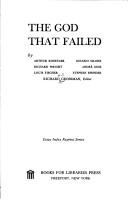
The God that failed
The God That Failed is a classic work and crucial document of the Cold War that brings together essays by six of the most important writers of the twentieth century on their conversion to and subsequent disillusionment with communism. In describing their own experiences, the …

The Roots of Coincidence
The Roots of Coincidence is a 1972 book by Arthur Koestler. It is an introduction to theories of parapsychology, including extrasensory perception and psychokinesis. Koestler postulates links between modern physics, their interaction with time and paranormal phenomena. It is influenced by Carl Jung's concept of …
The lotus and the robot
A collection of essays about Koestler's experiences in India and Japan, especially his observation of religion and cultural practices.
The Yogi and the Commissar
The Yogi and the Commissar (1945) is a collection of essays of Arthur Koestler, divided in three parts: Meanderings, Exhortations and Explorations. In the first two parts he has collected essays written from 1942 to 1945 and the third part was written especially for this …
Janus
Janus is both a summing up and continuation of Koestler's work over the past twenty-five years, since he turned from politics to the sciences of life- or more precisely, to the 'evolution, creativity and pathology of the human mind'. The insights gained on that long …


The age of longing
Koestler's fifth work of fiction is probably the most moving since "Darkness at Noon." It is in some ways more ambitious than that memorable novel. In "Darkness at Noon," Koestler dealt with the Bolshevik mind and the human spirit; he helped dispel the mystery of …


The heel of Achilles
The Heel of Achilles: Essays 1968–1973 is a book by Arthur Koestler. It is a collection of writings, lectures, addresses, book reviews, newspaper articles, etc.




Stranger on the square
Stranger on the Square is the third volume of Arthur Koestler's autobiography, published posthumously in 1984. It was co-authored with his wife Cynthia Koestler, née Jefferies, and includes autobiographical notes of her as well. The book was published by Hutchinson, London 1984, 242 pages including …

Spanish Testament
Arrested by Franco's troops in 1937 while he was in Malaga as a foreign correspondent covering the civil war, and sentenced to death for espionage, Arthur Koestler awaited his execution in Seville prison for three months. A Spanish Testament’, first published in England in 1937, …

The case of the midwife toad
Work and theories of the Viennese biologist Paul Kammerer.