Get over it!


Imagine living here

This Place Is Cold
Focuses on the land, animals, plants, and climate of Alaska, presenting it as an example of a place where it is so cold your hair can freeze and break off.

This Place Is Wet
Focuses on the land, ecology, people, and animals of the Amazon rain forest in Brazil, presenting it as an example of a place where there is so much water that some houses need to be built on stilts.

This place is high
Surveys the living conditions in the Andes Mountains of Bolivia for the people and unusual animals that live there.
Ar drywydd gwyddoniaeth

Lots of rot
Discusses what causes rot and the role it plays in the cycle of living things and presents facts about mold, bacteria, and mildew. Includes experiments.

How the world works

Sneakers meet your feet
Follows the familiar materials of rubber, cotton, nylon and leather through the steps of manufacturing and marketing them as sneakers.

The scoop on ice cream
Outlines the ingredients and making of ice cream and the role played by the manufacturers, retailers, and suppliers of this popular dessert. Includes a taste test and recipe for the homemade variety.

More power to you
Explains electric power and other forms of power, answering such questions as "How does electric power make a light turn on?" Includes experiments and tricks.

The trip of a drip
Traces the journey water makes from, to, and through our homes.
Standalone books

Science Experiments You Can Eat
Experiments with food demonstrate various scientific principles and produce an eatable result. Includes fruit drinks, grape jelly, muffins, chop suey, yogurt, and junket.

How to really fool yourself
Demonstrations accompanied by explanations illustrate how and why the senses can be fooled.

I Fall Down
Simple experiments introduce the basic concept of gravity and its relationship to weight.

Bet you can't!
Describes more than sixty tricks based on scientific experiments described in the text.

I Get Wet (Vicki Cobb Science Play)
Renowned science author Vicki Cobb has concocted just the right formula for making scientific principles easy for even the youngest kids to understand.

How the doctor knows you're fine
Explains what happens during a physical examination by the doctor.

I Face the Wind (Robert F. Sibert Informational Book Honor (Awards))
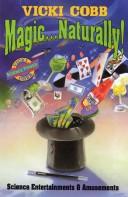
Magic ... naturally!
Explains and demonstrates scientific principles by using them to create magic tricks.

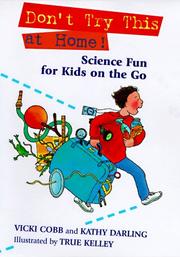
Don't Try This at Home
Provides instructions for a variety of science activities outside, arranged by such categories as school, parks, and vehicles.

See for Yourself
Science projects in the areas of chemistry, earth science, physical science, the human body, and technology.You'll find some experiments that are quick and easy and others that are very challenging. The materials you'll need come from the supermarket, the toy store,the hardware store, the stationary …

The secret life of school supplies
Discusses the scientific and technological principles involved in the manufacture of such school supplies as paper, ink, pencils, chalk, glue, and erasers. Includes experiments and formulas for making your own supplies.

Bet you can!
Describes more than sixty tricks based on scientific experiments described in the text.

I See Myself (Vicki Cobb Science Play)
Renowned science author Vicki Cobb illuminates the scientific principles of light and reflection in a way that even the youngest kids can understand.


Inspector Bodyguard patrols the land of U
Inspector Bodyguard's responses to a splinter in the foot, attack by cold germs, and overeating introduce the human body's defense system and other natural mechanisms by which it functions.

You gotta try this!
A collection of science experiments and activities, arranged in such categories as "Physical Attractions," "Curious Chemistry," and "Freaky Fluids."

Arts and crafts you can eat
Instructions for creating such artistic cuisine as mosaic salad, cheese intaglio, carved chocolate, pasta mobile, and peach pit ring.


Chemically Active
Gives instructions for performing a variety of experiments, using easily available materials, that illustrate some basic principles of chemistry.

Dirt & grime, like you've never seen
Using scanning electron microscopy, studies household dirt, dust, and germs, and the substances that are used to get rid of them.

Feeding yourself
Describes how knives, forks, spoons, and chopsticks came to be invented and how they are used today in eating.

Feeling Your Way
Describes many aspects of the sense of touch and includes several simple experiments which demonstrate how this sense works.

For your own protection
Describes various photographic methods that can reveal natural phenomena, very small or distant objects, or events that happen too quickly to be discernible to the naked eye.

Fun & games
Examines in text and special, detailed photographs how popcorn pops, how a ball bounces, how a phonograph needle "reads" the sound on a record, and many other things.

Fuzz does it!
Describes plant and animal fibers and how they are used to create a variety of textiles.
Gases
Discusses how scientists throughout history discovered the existence and characteristics of various gases.

How could we harness a hurricane?
Have you ever wondered how hurricanes become powerful enough to lift cars and level cities? In How Could We Harness a Hurricane, Vicki Cobb describes this natural phenomenon and the three things it's made of: air, water, and energy. Read about traveling to the eye …


Keeping clean
Describes how soap and water, toothpaste and toothbrush, and comb and brush were invented and how they keep us clean and healthy.

Light action!
Explains what light is and explores the basic principles of optics through experiments.

Logic
An introduction to the basic principles of logic, including chapters on different kinds of fallacies, deductive and inductive reasoning, and syllogisms.

More science experiments you can eat
Experiments with food demonstrate various scientific principles and produce eatable results. Includes beef jerky, cottage cheese, synthetic cola, and pudding.


The monsters who died
Discusses the methods used by paleontologists to decipher clues found in ancient bones and fossils which provide our only means of learning how dinosaurs lived and then became extinct.

The secret life of cosmetics
Briefly discusses the history of cosmetics and gives instructions for experiments which show how and why cosmetics such as shampoo, toothpaste, soap, and nail polish work.

The secret life of hardware
Examines the inventory of a hardware store from the tools to glues and suggests experiments which demonstrate the scientific principles and legends behind these items.

Truth on trial
A biography of the 16th-century Italian mathematician, physicist, and astronomer who questioned the accepted scientific theories of his time and was tried by the Inquisition for his ideas.

We dare you!
Hundreds of science experiments and projects are introduced.

Why can't you unscramble an egg?
Answers nine questions about matter, such as why does an ice cube float?, how much does air weigh?, how does wood burn? and other concepts about the nature of matter.

Why doesn't the earth fall up?
Answers nine questions about motion, explaining Newton's Laws of Motion, gravity, centrifugal force, and other principles of movement.

Writing it down
Simple descriptions of paper, pencils, pens, and crayons explain how they work and how they were invented.