Abhijit Vinayak Banerjee is an Indian American economist who is currently the Lemann Foundation Professor in Economics at the University of Zurich (UZH). He is co-founder and co-director of the Abdul Latif Jameel Poverty Action Lab (J-PAL), an MIT based global research center promoting the use of scientific evidence to inform poverty alleviation strategies.
From Wikipedia · CC BY-SA 4.0
12 books in our catalogue.
2011
320 pages
Business & Economics
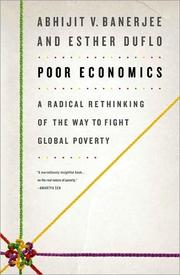
"Billions of government dollars, and thousands of charitable organizations and NGOs, are dedicated to helping the world's poor. But much of the work they do is based on assumptions that are untested generalizations at best, flat out harmful misperceptions at worst. Banerjee and Duflo have …
2019
416 pages
Business & Economics
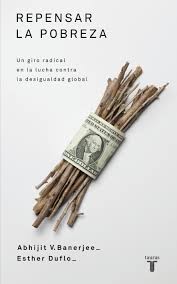
Figuring out how to deal with today's critical economic problems is perhaps the great challenge of our time. Much greater than space travel or perhaps even the next revolutionary medical breakthrough, what is at stake is the whole idea of the good life as we …
2006
470 pages
"Understanding poverty and what to do about it, is perhaps the central concern of all of economics. Yet the lay public almost never gets to hear what leading professional economists have to say about it. This volume brings together twenty-eight essays by some of the …
2019
403 pages
Business & Economics
"Figuring out how to deal with today's critical economic problems is perhaps the great challenge of our time. Much greater than space travel or perhaps even the next revolutionary medical breakthrough, what is at stake is the whole idea of the good life as we …
2021
277 pages
Food & Cooking
2008
315 pages
Business & Economics
Bill Gates is more than the world's most successful capitalist; he's also the world's biggest philanthropist. Gates has approached philanthropy the same way he revolutionized computer software: with a fierce ambition to change the rules of the game. That's why at the 2008 annual meeting …
2002
30 pages
We begin the paper by laying out a simple methodology that allows us to determine whether firms are credit constrained, based on how they react to changes in directed lending programs. The basic idea is that while both constrained and unconstrained firms may be willing …
2002
27 pages
Economists are excessively influenced by the so-called positive economics view, which says that economists should only describe and not prescribe. Here I argue that this view is flawed because it makes unreasonably strong assumptions about what players (the agents taking economic decisions) know and understand. …