
Standalone books

Murmurs of Earth
Preface: On August 20th and September 5th, 1977, two extraordinary spacecraft called Voyager were launched to the stars. After what promises to be a detailed and thoroughly dramatic exploration of the outer solar system from Jupiter to Uranus between 1979 and 1986, these space vehicles …

Coming of age in the Milky Way
Traces the evolution of humanity's need to understand space and time from late-prehistoric musings to the "supersymmetry" theories of space-time advanced as the second millennium comes to a close.
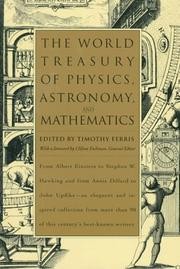
The World treasury of physics, astronomy, and mathematics
From the Publisher: An astonishing cast of more than ninety renowned writers provides thoughtful and lucid reflections on some of the major scientific topics of our time-from black holes and galaxies to artificial intelligence and chaos theory. Featuring essays, articles, and poems penned by notables …

Perfectly reasonable deviations from the beaten track
One of the towering figures of twentieth-century science, Richard Feynman possessed a curiosity that was the stuff of legend. Even before he won the Nobel Prize in 1965, his unorthodox and spellbinding lectures on physics secured his reputation amongst students and seekers around the world. …

The future of spacetime
"Our minds tell us that some things in the universe must be true. The new physics tells us that they are not, and in the process it blurs the line between science and science fiction. Here are six essays by those who walk that line, …

The red limit
For centuries, it was assumed that our universe was static. In the late 1920s, astronomers defeated this assumption with a startling new discovery. From Earth, the light of distant galaxies appeared to be red, meaning that those galaxies were receding from us. This led to …

The science of liberty
In his most important book to date, award-winning author Timothy Ferris—"the best popular science writer in the English language today" (Christian Science Monitor)—makes a passionate case for science as the inspiration behind the rise of liberalism and democracy. Ferris argues that just as the scientific …


Seeing in the Dark
Seeing in the Dark is a poetic love letter to the skies and a stirring report on the revolution now sweeping amateur astronomy in which backyard stargazers link globally by the Internet are exploring deep space and making discoveries worthy of the professionals. Timothy Ferris …

The big idea
"From the Pythagorean theorem to DNA's double helix, from the discovery of microscopic life-forms to the theory of relativity--the big ideas of science and technology shape an era's worldview. Open this book, grasp the newest ideas from thought leaders of today, then spring off from …

The Mind's Sky
A look at the relationship between the cosmos and human beings explores the complexity of the human brain and what constitutes real intelligence and the nature of consciousness.


Spaceshots
80 photographs on a variety of extraterrestrial subjects give access to the world of space exploration and adventure.


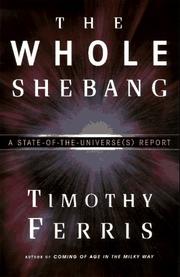
Whole Shebang a State of the Universes R
Timothy Ferris begins The Whole Shebang with a succinct account of how we have come to know what we know about the universe. Then he explains the meaning behind the exciting new developments that have put cosmology in the headlines - including the discovery of …