Philip Ball is a British science writer. For over twenty years he has been an editor of the journal Nature, for which he continues to write regularly.
From Wikipedia · CC BY-SA 4.0
34 books in our catalogue.
2004
528 pages
Philosophy & ReligionPolitics & SocietyScience & Nature
"Critical mass asks the question, Why is society the way it is? How does it emerge from a morass of individual interactions? Are there laws of nature that guide human affairs? Is anything inevitable about the ways humans behave and organize themselves, or do we …
2001
434 pages
HistoryScience & Nature
"Bright Earth provides a glimpse into a little-explored avenue in the history of art and science: the creation of pigments and dyes and their influence on painting, as well as on fashion, merchandising, and the textile and chemical industries. For as long as artists have …
2018
384 pages
An exhilarating tour of the contemporary quantum landscape, Beyond Weird is a book about what quantum physics really means--and what it doesn't. Science writer Philip Ball offers an up-to-date, accessible account of the quest to come to grips with the most fundamental theory of physical …
2012
465 pages
HistoryScience & Nature
Explores the evolution of curiosity from stigma to scientific stimulus through a look at the inventions and discoveries made between the sixteenth and eighteenth centuries, and details how curiosity functions in science today. Looking closely at the sixteenth through eighteenth centuries, Ball vividly brings to …
2016
288 pages
Science & Nature
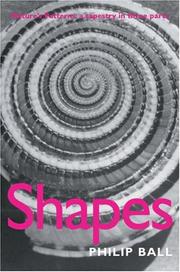
"Though at first glance the natural world may appear overwhelming in its diversity and complexity, there are regularities running through it, from the hexagons of a honeycomb to the spirals of a seashell and the branching veins of a leaf. Revealing the order at the …
2016
160 pages
Science & Nature
2023
560 pages
Science & Nature
2006
436 pages
Biography & MemoirFantasyHistory
"Philip Theophrastus Aureolus Bombastus von Hohenheim - known to later ages as Paracelsus - stands on the borderline between medieval and modern; a name that is familiar but a man who has been hard to perceive or understand." "But who was Paracelsus and what did …
2010
452 pages
Art & PhotographyPolitics & Society
The Music Instinct Philip Ball provides the first comprehensive, accessible survey of what is known--and what is still unknown--about how music works its magic, and why, as much as eating and sleeping, it seems indispensable to humanity. --from publisher description
2008
320 pages
History
Chartres Cathedral, south of Paris, is revered as one of the most beautiful and profound works of art in the Western canon. But what did it mean to those who constructed it in the twelfth and thirteenth centuries? And why, during this time, did Europeans …
1999
384 pages
"H[subscript 2]O begins by transporting us back to the Big Bang and the formation of galaxies to witness the birth of water's constituent elements: hydrogen and oxygen. Philip Ball shows how these two elements spread through unimaginable expanses of space before combining to form seas …
1999
287 pages
Science & Nature
2016
320 pages
"From the Yangtze to the Yellow River, China is traversed by great waterways, which have defined its politics and ways of life for centuries...In The Water Kingdom, Ball takes us on a grand journey through China's past and present, showing how the complexity and energy …
2004
186 pages
Science & Nature
This work traces the history and cultural impact of the elements on humankind, and examines why people have long sought to identify the substances around them.
2014
160 pages
"30-Second Quantum Theory tackles a mindbendingly mysterious area of physics, introducing the 50 most significant quantum quandaries and ideas. At a time when the quantum physics of electronics is an everyday essential and new quantum developments make headline news, you will visit parallel worlds, ride …
2019
328 pages
Psychology & Self-Help
A cutting-edge examination of what it means to be human and to have a 'self' in the face of new scientific developments in genetic editing, cloning and neural downloading. After seeing his own cells used to grow clumps of new neurons essentially, mini-brains, Philip Ball …
2014
321 pages
If offered the chance--by cloak, spell or superpower--to be invisible, who wouldn't want to give it a try? We are drawn to the idea of stealthy voyeurism and the ability to conceal our own acts, but as desirable as it may seem, invisibility is also …
2000
417 pages
"Life's Matrix tells of water's origins, its history, and its fascinating pervasiveness: there are, for example, at least fourteen different forms of ice. An exploration of water on other planets highlights the possibilities of life beyond Earth. Life's Matrix reveals the unexpected in the most …
2003
170 pages
Science & Nature
"The processes in a single living cell are akin to that of a city teeming with molecular inhabitants that move, communicate, cooperate, and compete. In this Very Short Introduction, previously published as Stories of the Invisible. Philip Ball explores the role of the molecule in …
2008
266 pages
"Ball takes us on an inspiring journey into the depths of nature, encompassing all the sciences, in which we discover that broad and elegant principles underpin the formation of the countless beautiful patterns around us."--Inside jacket.
2011
464 pages
Art & PhotographyPolitics & Society
2005
212 pages
Science & Nature
2019
272 pages
Psychology & Self-Help
2014
303 pages
HistoryScience & Nature
2013
303 pages
HistoryScience & Nature
"[This book] .. tells the story of physics under Hitler. While some scientists tried to create an Aryan physics that excluded any "Jewish ideas", many others made compromises and concessions as they continued to work under the Nazi regime. Among them were three world-renowned physicists …
2001
204 pages
Science & Nature
2021
368 pages
"Some stories keep returning, each time reimagined to fit the occasion. In some cases, we know them without having read the originals, and in a few brief sentences we can sketch the essential plot points and key characters. Robinson Crusoe, Frankenstein, Dracula, Dr. Jekyll and …
2011
379 pages
Philosophy & ReligionScience & Nature
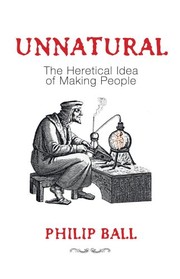
"Can we make a human being? That question has been asked for many centuries, and has produced recipes ranging from the homunculus of the medieval alchemists and the clay golem of Jewish legend to Frankenstein's monster and the mass-produced test-tube babies in 'Brave New World'. …