Lewis Mumford was an American historian, sociologist, philosopher of technology, and literary critic. Particularly noted for his study of cities and urban architecture, he had a broad career as a writer. He made significant contributions to social philosophy, American literary and cultural history, and the history of technology.
From Wikipedia · CC BY-SA 4.0
28 books in our catalogue.
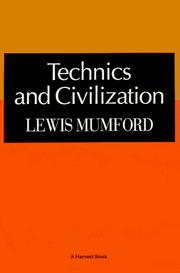
1934
495 pages
HistoryPolitics & SocietyScience & Nature
'Technics and Civilization' first presented its compelling history of the machine and critical study of its effects on civilization in 1934 -- before television, the personal computer, and the Internet. Drawing upon art, science, philosophy, and the history of culture, Lewis Mumford explained the origin …
Standalone books
1961
657 pages
Politics & Society
Examines the development and nature of the city from Egypt to Mesopotamia, Greece, Rome and the Middle Ages to the modern world.
1967
342 pages
The Myth of the Machine is a two-volume book by Lewis Mumford that takes an in-depth look at the forces that have shaped modern technology since prehistoric times. The first volume, Technics and Human Development, was published in 1967, followed by the second volume, The …
1970
496 pages
Politics & Society
In this concluding volume of The Myth of the Machine, Mumford brings to a head his radical revisions of the stale popular conceptions of human and technological progress. Far from being an attack on science and technics, The Pentagon of Power seeks to establish a …
1938
586 pages
Art & PhotographyHistory
1952
162 pages
Art & PhotographyPhilosophy & Religion
1951
342 pages
Psychology & Self-Help
Discusses the ultimate ethical and religious issues that confront modern man and offers a new orientation, directed to the renewal of life and the reintegration of modern civilization. -- Publisher's description.
1986
391 pages
Art & PhotographyHistory
This volume brings together representative selections of Lewis Mumford's major writings on the central concerns of his life. Praised by Malcolm Cowley as "the last of the great humanists," Mumford (1895-1990) produced a body of cultural criticism and commentary that for its range and richness …
1924
238 pages
Art & Photography
Great classic of American cultural history and important study of American architecture and civilization, still stimulating in its sweep and insights. Discusses the early New England towns, vernacular building, Colonial and Federal periods, Henry Hobson Richardson and other important architects of the late 19th century, …
1931
266 pages
Art & PhotographyHistory
A picture of the "buried renaissance" of the post-Civil War period, and the founding of modern architecture (Sullivan, Richardson, Root, Roebllng), landscape development (Marsh, Olmstead, Eliot), and the graphic arts (Homer, Eakins, Ryder). 2nd revised, enlarged edition. Bibliography. 12 illustrations,
1944
467 pages
History
A study of the development of the personality and the community.
1929
256 pages
Biography & Memoir
1963
246 pages
Art & PhotographyHistory
1956
264 pages
Art & Photography
1982
500 pages
Biography & Memoir
1972
162 pages
Art & PhotographyPhilosophy & Religion
"ART AND TECHNICS traces the relationship, throughout history, between two conflicting impulses within man: the artistic, which is subjective, and the 'technical', which is objective."--Back cover.
1940
248 pages
Politics & Society
2003
388 pages
Biography & Memoir
Herman Melville is a biography of the American author Herman Melville by Lewis Mumford, first published in 1929. Mumford, who felt a close affinity with Melville, gives both an account of the author's life and an interpretation of his works in the book, devoting particular …
2007
265 pages
Art & PhotographyHistory
1946
314 pages
Politics & Society