Francis Yoshihiro Fukuyama is an American political scientist, political economist, and international relations scholar. He is best known for his book The End of History and the Last Man (1992), which controversially argued that the worldwide spread of liberal democracies and Western free-market capitalism may represent the final step in humanity's sociocultural evolution and political struggle and the final form of human government.
From Wikipedia · CC BY-SA 4.0
27 books in our catalogue.
1992
421 pages
HistoryPhilosophy & ReligionPolitics & Society
Observing totalitarian and authoritarian governments falling around the world, Fukuyama develops an hypothesis that the end state of all this change will be liberal democracy everywhere (The End of History), and considers how people will react (The Last Man).
2014
673 pages
Business & EconomicsHistoryPolitics & Society
"The second volume of the bestselling landmark work on the history of the modern state Writing in The Wall Street Journal, David Gress called Francis Fukuyama's Origins of Political Order "magisterial in its learning and admirably immodest in its ambition." In The New York Times …
2011
608 pages
HistoryPolitics & Society
Francis Fukuyama examines the paths that different societies have taken to reach their current forms of political order.
1995
457 pages
Business & Economics
In Trust, a sweeping assessment of the emerging global economic order "after History," Fukuyama examines a wide range of national cultures in order to divine the hidden principles that make a good and prosperous society, and his findings strongly challenge the orthodoxies of both left …
2018
240 pages
Politics & Society
2011
535 pages
HistoryPolitics & Society
2002
272 pages
HistoryPhilosophy & ReligionPolitics & Society
"In 1989, Francis Fukuyama made his now-famous pronouncement that because the major alternatives to liberal democracy had exhausted themselves, history as we knew it had reached its end. Ten years later, he revised his argument: we hadn't reached the end of history, he wrote, because …
2003
208 pages
Politics & Society
1999
368 pages
HistoryPolitics & Society
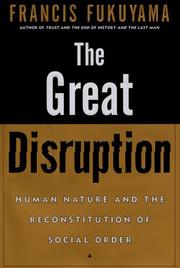
The Great Disruption begins by observing that over the past thirty years, the United States and other developed countries have undergone a profound transformation from industrial to information societies; knowledge has replaced mass production as the basis of wealth, power, and social interaction. At the …
2006
240 pages
Politics & Society
2006
262 pages
Business & Economics
2006
233 pages
Politics & Society
2007
198 pages
Politics & Society
"Focuses on developing analytical tools to anticipate and manage low-probability events. Addresses psychological and institutional obstacles preventing planning for low-probability tragedies and allocating necessary resources. Pinpoints failures---institutional and personal---that allowed events to surprise leaders and examines philosophies and methodologies of forecasting. Discusses low-probability, high-impact contingencies …
1994
224 pages
Politics & Society
A series of writers examine the economic and moral issues surrounding immigration.
2021
HistoryPhilosophy & ReligionPolitics & Society