Karel Čapek was a Czech writer, playwright, critic and journalist. He has become best known for his science fiction, including his novel War with the Newts (1936) and play R.U.R., which introduced the word robot. He also wrote many politically charged works dealing with the social turmoil of his time. Influenced by American pragmatic liberalism, he campaigned in favor of free expression and strongly opposed the rise of both fascism and communism in Europe.
From Wikipedia · CC BY-SA 4.0
37 books in our catalogue.
1920
108 pages
Poetry & DramaScience Fiction
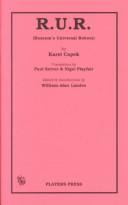
"In 1920 Čapek wrote what was to become his most famous work, the play 'R.U.R. (Rossum's Universal Robots)', a meditation on the themes of humanity and subjugation that introduced the 'robot'. He was prolific throughout the 1920s, his plays addressing a range of subjects, although …
1937
97 pages
Unlike many other plays by Čapek, 'The White Plague' is pervaded not by hope with a little nihilism, but with anguish and fear for what the future would hold. Written in the late 1930s, shortly before the Munich Agreement delivered much of Czechoslovakia into Nazi …
1937
277 pages
Philosophy & Religion
1922
232 pages
Science Fiction
The Czech writer Karel Čapek wrote his novel Továrna na absolutno in 1922. It was translated into English and published by Macmillan in 1927 as The Absolute at Large. The novel is a satirical piece of science fiction, and starts with the invention of an …
1924
309 pages
Science Fiction
16. vydání
1932
257 pages
FantasyLiterary & Classics
1936
309 pages
Historical FictionHumourScience Fiction
Originally written in 1936, two years before Capek's death and three years before the Nazi invasion of Czechoslovakia, War with the Newts is considered by many to be Capek's greatest book. Working in the "fantastic" satiric tradition of Wells, Orwell, and Vonnegut, Capek chronicles the …
1945
160 pages
Literary & Classics
"Contains twenty-nine short sketches of famous characters."
1922
96 pages
Poetry & Drama
Věc Makropulos je divadelní hra českého spisovatele a dramatika Karla Čapka. Tato hra měla premiéru v roce 1922 v Městském divadle na Vinohradech v Praze. Zabývá se otázkou nesmrtelnosti a práva člověka prodlužovat si uměle život.
1969
588 pages
Philosophy & Religion
Toto významné dílo Karla Čapka vznikalo v letech 1928–1935 na základě rozhovorů s prvním československým prezidentem T.G. Masarykem. První část vypovídá o prezidentově životě od dětství až po jeho vstup do vysoké politiky. Druhá polovina je rozhovor spisovatele s prezidentem na téma noetiky, filosofie, náboženství …
Standalone books
1974
394 pages
Science fiction: before Christ and after 2001, an introduction / Ray Bradbury -- The gun without a bang / Robert Sheckley -- Crabs take over the island / Anatoly Dnieprov -- All watched over by machines of loving grace / Richard Brautigan -- EPICAC / …
1935
65 pages
Children'sFantasy
The author describes the growth and naughty but endearing behavior of his fox terrier Dashenka during her first year of life.
1994
265 pages
Literary & Classics
A collection of philosophical crime stories. Typical is The Last Judgment in which God refuses to pass judgment on a man accused of murder, preferring to leave the verdict to a court of men. The reason? Being God he knows everything there is to know, …
1999
327 pages
Poetry & Drama
1932
287 pages
Literary & Classics
Capek wrote 48 stories that deconstruct the mystery story by breaking one rule here, three rules there, and yet also make for wonderful reading. His unique approaches to the mysteries of justice and truth are full of the ordinary and the extraordinary, humor and humanism.
1929
279 pages
General Fiction
2008
191 pages
Een 'doodgewoon iemand', een spoorwegbeambte, kijkt terug op zijn leven en komt tot de slotsom dat dat idyllische, geordende leventje van hem ook anders kan worden opgevat.
1961
285 pages
General Fiction
2003
223 pages
Biography & MemoirPolitics & Society
1948
469 pages
General Fiction
"This trilogy of novels was the culmination of Karel Čapek's career. The novels share neither characters nor events; instead, they approach the problem of knowing people--of mutual understanding--in a variety of ways. Detectives faced with a murder reconstruct the crime, but not the character of …
1990
407 pages
General Fiction