The History of Sexuality


Foucault's lectures at the Collège de France
Il faut défendre la société
"From 1971 until his death in 1984, Foucault taught at the College de France, one of the most unique and renowned institutions of higher learning in the world. The College enrolls no students and confers no degrees. Professors are required to deliver lectures to the …


Naissance de la biopolitique
The Birth of Biopolitics is a part of a lecture series by French philosopher Michel Foucault at the Collège de France between 1978 and 1979 and published posthumously. In it, Foucault develops further the notion of biopolitics introduced in a previous lecture series, Security, Territory, …

Sécurité, territoire, population
"Le cours prononcé par Michel Foucault au Collège de France de janvier à avril 1978, Sécurité, Territoire, Population, marque un tournant dans le développement de sa recherche. Partant du problème du bio-pouvoir, introduit à la fin du cours de 1976, "Il faut défendre la société-, …
Revisions (Black Dog Pub.)

Gérard Fromanger
This study considers the relationship between the painter and his model as eroticized merchandise within consumer society. The text examines the painting versus photography debate, from Ingres to the era of hyperrealism.
Hautes études


Standalone books
Discipline and Punish
English version of "Surveiller et punir : naissance de la prison"
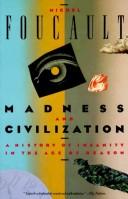
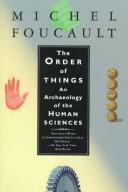
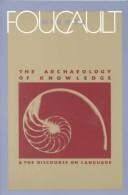


Power/knowledge
"Michel Foucault has become famous for a series of books that have permanently altered our understanding of many institutions of Western society. He analyzed mental institutions in the remarkable Madness and Civilization; hospitals in The Birth of the Clinic; prisons in Discipline and Punish; and …
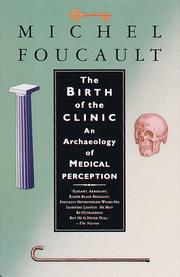
Naissance de la clinique
"In the eighteenth century, medicine underwent a mutation. For the first time, medical knowledge took on a precision that had formerly belonged only to mathematics. The body became something that could be mapped. Disease became subject to new rules of classification. And doctors begin to …

This Is Not a Pipe
What does it mean to write "This is not a pipe" across a bluntly literal painting of a pipe? René Magritte's famous canvas provides the starting point for a delightful homage by French philosopher and historian Michel Foucault. Much better known for his incisive and …

The Foucault reader
Michael Foucault's writing has shaped the teaching of half a dozen disciplines, ranging from literary criticism to the history of criminology. But none of his books offers a satisfactory introduction to the entire complex body of his work. The Foucault Reader precisely serves that purpose. …

Maladie mentale et psychologie
Analyzes the specifics of mental illness and the forms attributed to it by psychology and determines the social conditions that define the status of mental illness.

Les mots et les choses
When one defines 'order' as a sorting of priorities, it becomes beautifully clear what Foucault is doing here. He weaves an intensely complex history of thought. He dips into literature, art, economics and even biology.

Power
"This volume draws together Foucault's contributions to what he saw as the still-underdeveloped practice of political analysis. It covers the domains Foucault helped to make part of the core agenda of Western political culture - medicine, psychiatry, the penal system, sexuality - illuminating and expanding …

History of madness
When it was first published in France in 1961 as Folie et Déraison: Histoire de la Folie à l'âge Classique, few had heard of a thirty-four year old philosopher by the name of Michel Foucault. By the time an abridged English edition was published in …
Ethics
Few philosophers have had as strong an influence on the twentieth century as Michel Foucault. In 1994, ten years after his death, his French publisher, Gallimard, issued Dits et ecrits, the first complete collection of all Foucault's publications outside his monographs. It is a great …



I, Pierre Rivière, having slaughtered my mother, my sister, and my brother ...


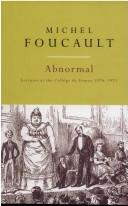
Abnormal
El curso sobre Los anormales, dictado en el Collége de France entre enero y marzo de 1975, prolonga los análisis que Michel Foucault consagró desde 1970 a la cuestión del saber y el poder: poder disciplinario, poder de normalización, biopoder. A partir de múltiples fuentes …

Language, counter-memory, practice
Because of their range, brilliance, and singularity, the ideas of the philosopher-critic-historian Michel Foucault have gained extraordinary currency throughout the Western intellectual community. This book offers a selection of seven of Foucault's most important published essays, translated from the French, with an introductory essay and …


Security, territory, population
"Marking a major development in Foucault's thinking, this book derives from the lecture course which he gave at the College de France between January and April, 1978. Taking as his starting point the notion of "bio-power," introduced both in his 1976 course Society Must be …


The Punitive Society
"These thirteen lectures on the 'punitive society,' delivered at the Collège de France in the first three months of 1973, examine the way in which the relations between justice and truth that govern modern penal law were forged, and question what links them to the …


Politics, philosophy, culture
The late Michael Foucault left behind an impressive collection of interviews that demonstrate the breadth and diversity of his concerns and offer a unique opportunity to come to terms with the entire body of his work.

Foucault
Michael Foucault's intellectual journeys carried him across many different disciplines and often into uncharted lands. His astonishing discoveries and claims have been received with both unbridled enthusiasm and vehement dissent. This collection of essays is the first to bring together major criticisms of Foucault by …


History of Sexuality
Michel Foucult offers an iconoclastic exploration of why we feel compelled to continually analyze and discuss sex, and of the social and mental mechanisms of power that cause us to direct the questions of what we are to what our sexuality is.

L'histoire de la sexualité, t.4
"Brought to light at last--the fourth volume in the famous History of Sexuality series by one of the most influential thinkers of the twentieth century, his final work, which he had completed, but not yet published, upon his death in 1984 Michel Foucault's philosophy has …


The birth of biopolitics
"Michel Foucault's 1979 lectures at the College de France, The Birth of Biopolitics, pursue and develop further the themes of his lectures from the previous year, Security, Territory, Population. Having shown how eighteenth century political economy marks the birth of a new governmental reason, Foucault …

The courage of the truth (the government of self and others II)
"The course given by Michel Foucault from February to March 1984, under the title 'The Courage of Truth', was his last at the Collège de France. His death shortly after, on June 25th, tempts us to detect a philosophical testament in these lectures, especially in …

The order of things
When one defines ""order"" as a sorting of priorities, it becomes beautifully clear as to what Foucault is doing here. With virtuoso showmanship, he weaves an intensely complex history of thought. He dips into literature, art, economics and even biology in The Order of Things, …


Archéologie du savoir
The purpose of The Archaeology of Knowledge is to suggest how rhetoric can be studied and understood in its relationship with power and knowledge.


Introduction to Kant's Anthropology
"In his critical interpretation of Kant's Anthropology, Michel Foucault warns against the dangers of treating psychology as a new metaphysics. Instead, he explores the possibility of studying man empirically as he is affected by time, art and technique, self-perception, and language. If man is both …


Las palabras y las cosas
El proyecto de la obra es triple: primero, es una arqueología, un estudio sistemático que busca reconstituir, a través de las obras de teóricos y pragmáticos, las configuraciones mentales que dan cuenta, desde finales del Renacimiento, de la naturaleza de las ciencias y del modo …


Religion and culture
Foucault's work has affected almost every discipline in the humanities, but few have appreciated how his work engaged with theological and religious themes. This reader brings together a selection of his essays, lectures and interviews on religion.


Subjectivity and Truth
1 online resource


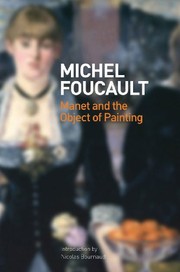
Manet and the Object of Painting
"Originally delivered as a lecture in Tunis in 1971, here translated into English for the first time, the text takes the form of a commentary on thirteen of Manet's paintings." --book jacket.


Speech Begins After Death
" In 1968, Michel Foucault agreed to a series of interviews with critic Claude Bonnefoy, which were to be published in book form. Bonnefoy wanted a dialogue with Foucault about his relationship to writing rather than about the content of his books. The project was …


The Foucault effect
Based on Michel Foucault's 1978 and 1979 lectures at the College de France on governmental rationalities and his 1977 interview regarding his work on imprisonment, this volume is the long-awaited sequel to Power/Knowledge. In these lectures, Foucault examines the art or activity of government both …

The Government of Self and Others
An exciting and highly original examination of the practices of truth-telling and speaking out freely (parresia) in ancient Greek tragedy and philosophy. Foucault discusses the difficult and changing practices of truth-telling in ancient democracies and tyrannies.


Disorderly families
"Drunken and debauched husbands; libertine wives; vagabonding children. These and many more are the subjects of requests for confinement written to the king of France in the eighteenth century. These letters of arrest (lettres de cachet) from France's Ancien Regime were often associated with excessive …

Dits et écrits, 1954-1988


Folie et déraison
D’abord commande éditoriale, puis projet de doctorat suédois, enfin thèse en français soutenue en mai 1961, Folie et Déraison. Histoire de la folie à l’âge classique de Michel Foucault est devenue un classique des sciences sociales françaises. Publié successivement, et dans différents formats, aux éditions …

Herméneutique du sujet
"The Hermeneutics of the Subject is the third volume in the collection of Michel Foucault's lectures at the College de France, one of the world's most prestigious institutions. Faculty at the College give public lectures, in which they present works-in-progress on any subject of their …


Le Beau Danger
Autumn 1968: Foucault, at the invitation of the critic Claude Bonnefoy, meets him several times to discuss a book project. It is neither an interview nor a dialogue that the two men engage in, but an unprecedented exercise in speech; for the only time in …