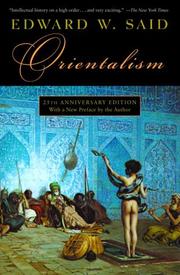
Edward Wadie Said was a Palestinian and American academic, literary critic, and political activist. As a professor of literature at Columbia University, he was among the founders of post-colonial studies. As a cultural critic, Said is best known for his book Orientalism (1978), a foundational text which critiques the cultural representations that are the bases of Orientalism—how the Western world perceives the Orient. His model of textual analysis transformed the academic discourse of researchers in literary theory, literary criticism, and Middle Eastern studies.
From Wikipedia · CC BY-SA 4.0
40 books in our catalogue.
1978
400 pages
History
Orientalism is a 1978 book by Edward W. Said, in which the author discusses Orientalism, defined as the West's patronizing representations of "The East"—the societies and peoples who inhabit the places of Asia, North Africa, and the Middle East. According to Said, orientalism (the Western …
1993
509 pages
Philosophy & Religion
In a series of essays, Said argues the impact of mainstream culture (mainly British writers of the 19th and early 20th century, like Jane Austen and Rudyard Kipling) on colonialism and imperialism, and conversely how imperialism, resistance to it, and decolonization influenced the English and …
1979
265 pages
History
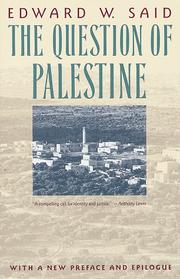
This original and deeply provocative book was the first to make Palestine the subject of a serious debate—one that remains as critical as ever. With the rigorous scholarship he brought to his influential Orientalism and an exile's passion (he is Palestinian by birth and has …
1981
224 pages
HistoryPhilosophy & ReligionPolitics & Society
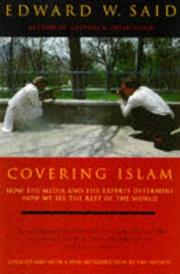
An unusually sharp look at the way in which the U.S. press and experts have dealt with the crisis in the Middle East and Iran.
1986
174 pages
Politics & Society
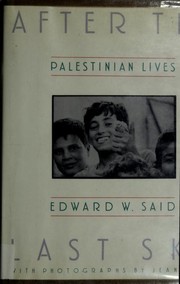
"A searing portrait in words and photographs of Palestinian life and identity that is at once an exploration of Edward Said's own dislocated past and a testimony to the lives of those living in exile."--BOOK JACKET.
1999
384 pages
Biography & MemoirHistory
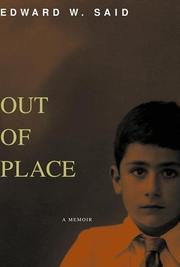
"Out of Place is an extraordinary story of exile, a narrative of many departures, a celebration of an irrecoverable past. A fatal medical diagnosis in 1991 convinced Edward Said that he should leave a record of where he was born and spent his childhood, and …
1997
208 pages
General Fiction
this book was mistakenly listed under Edward Said. Said only wrote the forward, which is 5 pages.
2000
617 pages
Politics & Society
This Long-Awaited Collection of literary and cultural essays by Edward W. Said, the first since Harvard University Press published The World, the Text, and the Critic in 1983, reconfirms what no one can doubt -- that Said is the most impressive, consequential, and elegant critic …
1988
304 pages
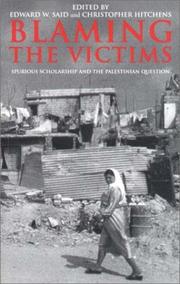
Since the 1948 war which drove them from their homeland, the Palestinian people have consistently been denied the most basic democratic rights. [This book] shows how the historical fate of the Palestinians has been justified by spurious academic attempts to dismiss their claim to a …
1994
121 pages
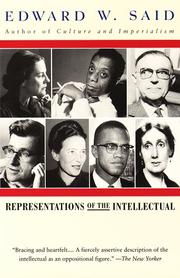
Celebrated humanist, teacher, and scholar, Edward W. Said here examines the ever-changing role of the intellectual today. In these six stunning essays - delivered on the BBC as the prestigious Reith Lectures - Said addresses the ways in which the intellectual can best serve society …
2003
96 pages
Politics & Society
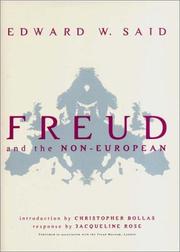
"Using an array of material from literature, archaeology and social theory, Edward Said's essay is an exploration of the profound implications in Sigmund Freud's Moses and Monotheism for Middle-East politics today." "Demonstrating an abiding interest in Freud's work and its influence upon his own, Said …
2004
335 pages
Politics & Society
"In From Oslo to Iraq and the Road Map, Said writes about the second intifada and about the so-called peace process, which he terms a kind of "fast-food peace" underscored by "malevolent sloppiness." He discusses the breach of democracy in the last American presidential election …
1975
414 pages
General Fiction
xvii, 414 pages ; 23 cm
2006
176 pages
Philosophy & ReligionPsychology & Self-Help
In his fascinating last book, Edward Said looks at a selection of essays, poems, novels, films, and operas to determine what late style may explain about the evolution of the creative life. He discusses how the approaching death of an artist can make its way …
2001
485 pages
Politics & Society
2002
208 pages
Art & PhotographyPolitics & Society
These free-wheeling, often exhilarating dialogues--which grew out of the acclaimed Carnegie Hall Talks--are an exchange between two of the most prominent figures in contemporary culture: Daniel Barenboim, internationally renowned conductor and pianist, and Edward W. Said, eminent literary critic and impassioned commentator on the Middle …
1994
450 pages
Politics & Society
In this brilliant collection of pieces on the question of Palestinian self-determination, Edward Said - the most celebrated, visible, and outspoken Arab writing in America today - looks at the issues behind the Palestinian struggle for statehood. An Arab born in Jerusalem, educated there and …
1991
109 pages
Art & PhotographyPolitics & Society
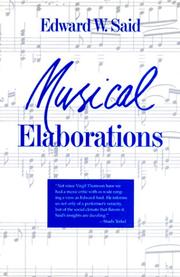
Examines the performance of Western high-art music, the politicized theorizing of it, and the use of "melody, solitude, and affirmation" in it.
2003
154 pages
Politics & Society
In the radically changed and highly charged political atmosphere that has overtaken the United States -- and to varying degrees the rest of the world -- since September 11, 2001, the notion that cultures can harmoniously and productively coexist has come to seem like little …
2007
344 pages
Art & Photography
2000
472 pages
Politics & Society
Presents key selections from the works of Edward Said.
2003
225 pages
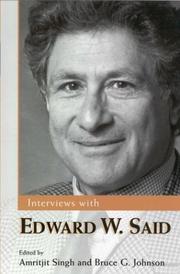
In this book of interviews, Edward W. Said discusses the centrality of popular resistance to his understanding of culture, history, and social change. He reveals his thoughts on the war on terrorism, the war in Afghanistan, and the Israeli-Palestinian conflict, and lays out a compelling …
1995
197 pages
Ever since Yasir Arafat and Yitzhak Rabin shook hands on the White House lawn, Israel and the Palestinian people have been engaged in what commentators persist in calling "the peace process." Yet Israel remains racked by violence and continuing land seizures, and Palestinians are more …
1999
72 pages
Politics & Society