Seeds-of-thought


Standalone books

Nietzsche
Nietzsche claimed to be a philosopher of the future, but he was appropriated as a philosopher of Nazism. His work inspired a long study by Martin Heidegger and essays by a host of lesser disciples attached to the Third Reich. In 1935, however, Karl Jaspers …


Vom Ursprung und Ziel der Geschichte
First published in English in 1953, this important book from eminent philosopher Karl Jaspers deals with the philosophy of the history of mankind. More specifically, its avowed aim is to assist in heightening our awareness of the present by placing it within the framework of …

General psychopathology
"This book represents Professor Jaspers' most important contribution to the work of the 'Heidelberg School ' of which he was a member. Not only does it contain valuable clinical material but it also presents a comprehensive discussion of what is implied in the concept of …


The great philosophers
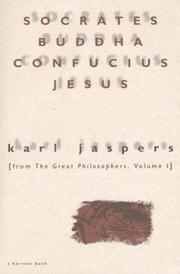
[1] The foundations: The paradigmatic individuals: Socrates, Buddha, Confucius, Jesus. The seminal founders of philosophical thought: Plato, Augustine, Kant -- [2] The original thinkers: Anaximander, Heraclitus, Parmenides, Plotinus, Anselm, Nicholas of Cusa, Spinoza, Lao-Tzu, Nagarjuna -- [3] Xenophanes, Democritus, Empedocles, Bruno, Epicurus, Boehme, Schelling, Leibniz, …

Atombombe und die Zukunft des Menschen
One of the century's great philosophers assesses man's ability to stand up to the grimmest threat the world has ever known--nuclear warfare.


Schuldfrage
Shortly after the Nazi government fell, a philosophy professor at Heidelberg University lectured on a subject that burned the consciousness and conscience of thinking Germans. "Are the German people guilty?" These lectures by Karl Jaspers, an outstanding European philosopher, attracted wide attention among German intellectuals …


Reason and Existenz
The intent of Jaspers' philosophizing then is simply to recall us to our authentic situation. This recall is not itself a doctrine; it is only the stimulus to an inward action each must perform for himself in communication with others. Jaspers' Existenz-philosophy is thus an …


Way to wisdom
An introduction to the understanding of philosophy written for the general reader.


Kleine Schule des philosophischen Denkens
In this book, based on a series of television lectures, the author's main themes are "man and the universe; history and the present; politics; freedom; sociology and psychology; the ciphers of myth and metaphysics; love and death; philosophy in the world." Publishers note.


