The new Martin Gardner mathematical library

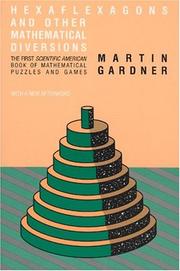
The Scientific American Book of Mathematical Puzzles & Diversions
Paradoxes and paperfolding, moebius variations and mnemonics, fallacies, brain-teasers, magic squares, topological curiosities, probability and parlor tricks, and a variety of ancient and new games and problems, from polyominoes, nim, hex and the Tower of Hanoi to four-dimensional ticktacktoe. Together with mathematical commentaries by Mr. …
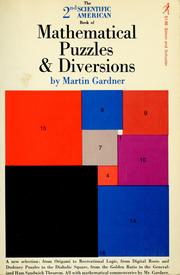
The 2nd Scientific American Book of Mathematical Puzzles & Diversions
Martin Gardner’s “Mathematical Games” Department ran monthly in SCIENTIFIC AMERICAN. This second book is composed entirely of new games and puzzles that appeared there since Mr. Gardner’s first collection was published in 1959. Offering a new feast of mathematical entertainments to charm both layman and …
Oz

The Wizard of Oz and Who He Was
A simplified version of the story of the little girl carried by a tornado to Oz, where she is befriended by three unusual creatures.
Standalone books

Mathematical Circus
The chapters of this book first appeared in Scientific American's monthly "Math Games" column. Among the topics covered, let's mention: optical illusions, random walks, Boolean algebra, spheres and hyperspheres, cyclic numbers, Fibonacci numbers. Solutions to all problems.
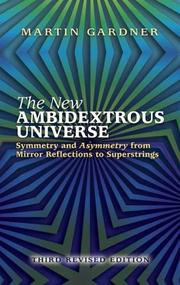
The Ambidextrous Universe
From where does the difference between left and right come? Is it a fundamental property of the universe, or is it arbitrary?

aha! Insight
Contains puzzles that first baffle and then delight problem solving addicts. Grew out of a collaboration between Bob Tappay and Martin Gardner to enliven the learning of mathematics.
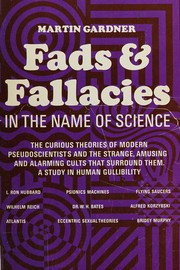
In the Name of Science
"A revised and expanded edition of the work first published in 1952 under the title In the name of science."

Mathenauts

Codes, Ciphers and Secret Writing
Explains in simple terms how to encode and decode messages in various ciphers, describes coding machines, and gives formulas for invisible ink.
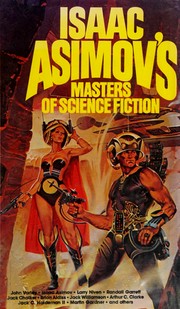
Isaac Asimov's Masters of Science Fiction
Introduction: Masters of Science Fiction - essay by Isaac Asimov Good-Bye, Robinson Crusoe - novelette by John Varley Quarantine - short story by Arthur C. Clarke Cautionary Tales - short story by Larry Niven The Case of the Defective Doyles - short story by Martin …
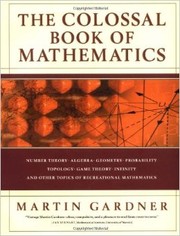
The Colossal Book of Mathematics
The author presents a selection of pieces from his Scientific American "Mathematical Games" column, presenting puzzles and concepts that range from arithmetic and geometrical games to the meaning of M.C. Escher's artwork.

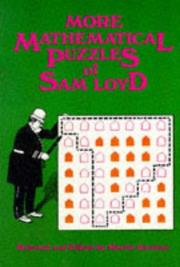
The Magic Numbers of Dr. Matrix
Martin Gardner's The Magic Numbers of Dr. Matrix contains the humorous explorations of numerological coincidences as explored by Dr. Matrix. There are three successive revised editions: The Numerology of Dr. Matrix, The Incredible Dr. Matrix and The Magic Numbers of Dr. Matrix. Each newer edition …


The snark puzzle book
Seventy-five brain teasers relating to Lewis Carroll's nonsense poem "The Hunting of the Snark."

Mental magic
A collection of math tricks using the magic of numbers in which the marvelous Professor Picanumba can seemingly predict random events in dozens of numerical exercises. Includes answers at the end.


Urantia
Martin Gardner, one of America's most acclaimed science writers, has here compiled the first complete history of a growing, modern religious cult. Gardner traces the cult's beginnings back to its "bible," The Urantia Book, a book supposedly revealed solely by celestial beings to correct the …


Perplexing Puzzles and Tantalizing Teasers
A collection of word and picture puzzles, riddles, and tricky questions. Includes answers at the back of the book.

The new age
Critical articles on Margaret Mead, Shirley MacLaine, Immanuel Velikovsky, Uri Geller, superstrings, psychic surgery, the Antichrist, psychokinesis, channeling, Christian television evangelists, L. Ron Hubbard, psychic astronomy, and similar topics.
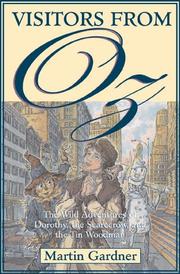
Visitors from Oz
Dorothy and friends return in this Oz sequel, this time to New York City, on the eve of the 100th anniversary of "The Wizard of Oz". Combining mathematical riddles with technological pyrotechnics and vivid suspense, Martin Gardner has created a new fable celebrating the power …


Mathematical magic show
On title page: More puzzles, games, diversions, illusions, & other mathematical sleight-of-mind from "Scientific American."
Space Puzzles
Brief introductions to space flight and the various bodies in the solar system are followed by sections of related puzzle questions. Answers are given at the back of the book.
Gardner's whys & wherefores
"Gardner's Whys and Wherefores includes articles on the puzzles in James Joyce's Ulysses and on the fantasies of Ray Bradbury, Arthur C. Clarke, Lord Dunsany, Gilbert Chesterton, and H. G. Wells. Gardner expresses strong opinions about the "anthropic principle," computer games capable of discovering scientific …


Science Fiction Puzzle Tales
By a mathematician famous for his "games" published regularly in "Scientific American", a series of 34 problems in the form of short science fiction stories published from 1976 in "Isaac Asimov's science fiction magazine". The interesting part of these problems comes is that each is …
The healing revelations of Mary Baker Eddy
Traces the life of Mary Baker Eddy, describes the founding and beliefs of Christian Science, looks at its connection with the New Thought movement, and discusses the reasons for the church's decline.

Are Universes Thicker Than Blackberries?
"In these essays, many of which originally appeared in The Skeptical Inquirer, Scientific American, and the Los Angeles Times, Gardner spans the realms of science and mathematics, literature, philosophy, religion, and mysticism. He examines influential scientific concepts, such as the possibility of multiple universes and …


Weird water & fuzzy logic
Never before has American education in science sunk so low, or the flood of books about bogus science risen so high. Books discrediting the paranormal are outnumbered by those promoting astrology, angels, parapsychology, bizarre forms of medicine and healing, the prophecies of Nostradamus, the secrets …

Dark Stars & Dragons
The Name of Our Field - essay by Isaac Asimov The Last Full Measure - short story by George Alec Effinger The Voyage of the Bagel - short story by Martin Gardner Pièce de Résistance - short story by J. F. Bone [as by Jesse …
From the Wandering Jew to William F. Buckley
"For over fifty years Martin Gardner has been writing witty, entertaining, and highly intelligent articles on an amazing range of topics. Best known for his works on popular science and mathematics, and as an incisive skeptical commentator on the paranormal, Gardner is also an accomplished …


Science Magic
A collection of tricks, stunts, and puzzles that explore the properties of water, air, friction, heat, motion, light, and more.

The Annotated Night Before Christmas
A collection of sequels, parodies, and imitations of Clement Moore's immortal ballad about Santa Claus.



Extraterrestrials & Eclipses
It's a Funny Thing - essay by Isaac Asimov Public Relations - short story by Ginger Kaderabek The Great Ring of Neptune - short story by Martin Gardner But Do They Ride Dolphins? - short story by Frederick S. Lord, Jr. One Rejection Too Many …


The Last Recreations
More than any of his other writing, Martin Gardner's "Mathematical Games" column in Scientific American cemented his reputation as America's premier writer on recreational mathematics and set the standard for the genre. The Last Recreations collects Gardner's columns from the last seven years before his …




Comets & Computers
Extraordinary Voyages - essay by Isaac Asimov Grimes at Glenrowan - short story by A. Bertram Chandler The Third Dr. Moreau - short story by Martin Gardner The Small Stones of Tu Fu - short story by Brian W. Aldiss A Hideous Splotch of Purple …

Isaac Asimov Presents The Great SF Stories 10 (1948)
Introduction - essay by Martin H. Greenberg Don't Look Now - short story by Henry Kuttner He Walked Around the Horses - novelette by H. Beam Piper The Strange Case of John Kingman - short story by Murray Leinster That Only a Mother - short …

Isaac Asimov's Marvels of Science Fiction
In the Country of the Blind, No One Can See - short story by Melisa Michaels Proud Rider - novelette by Barry B. Longyear The Three Robots of Professor Tinker - short story by Martin Gardner On the Q167 File - short story by John …


The night is large
The seven-decade-long sweep of Martin Gardner's career is one of the most extraordinary in the history of twentieth-century thought. A gentle muse, Gardner began publishing articles on philosophy, literature, science, and mathematics in the late 1930s, while at the University of Chicago. He has since …


The Universe in a Handkerchief
This book contains scores of intriguing puzzles and paradoxes from Lewis Carroll, the author of Alice in Wonderland, whose interests ranged from inventing new games like Arithmetical Croquet to important problems in symbolic logic and propositional calculus. Written by Carroll expert and well-known mathematics author …