Douglas N. Walton
1942–2020
Douglas Neil Walton was a Canadian academic and author, known for his books and papers on argumentation, logical fallacies and informal logic. He was a Distinguished Research Fellow of the Centre for Research in Reasoning, Argumentation, and Rhetoric (CRRAR) at the University of Windsor, Ontario, Canada, and before that (2008–2014), he held the Assumption Chair of Argumentation Studies at the University of Windsor. Walton's work has been used to better prepare legal arguments and to help develop artificial intelligence.
From Wikipedia · CC BY-SA 4.0
49 books in our catalogue.
1989
320 pages
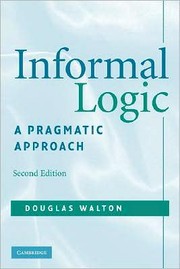
"Informal Logic is an introductory guidebook to the basic principles of constructing sound arguments and criticizing bad ones. Non-technical in approach, it is based on 186 examples, which Douglas Walton, a leading authority in the field of informal logic, discusses and evaluates in clear, illustrative …
1996
313 pages
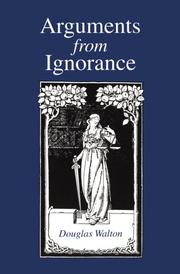
Arguments from Ignorance explores the situations in which the argument from ignorance (also known as the lack-of-knowledge inference, negative evidence, or default reasoning) functions as a respectable form of reasoning and those in which it is indeed fallacious. Douglas Walton draws on everyday conversations on …
2008
443 pages
"This book provides a systematic analysis of many common argumentation schemes and a compendium of ninety-six schemes. The study of these schemes, or forms of argument that capture stereotypical patterns of human reasoning, is at the core of argumentation research. Surveying all aspects of argumentation …
2005
343 pages
Philosophy & Religion
1990
395 pages
Philosophy & Religion
1996
218 pages
Philosophy & Religion
2014
315 pages
"The notion of burden of proof and its companion notion of presumption are central to argumentation studies. This book argues that we can learn a lot from how the courts have developed procedures over the years for allocating and reasoning with presumptions and burdens of …
1995
223 pages
This book develops a logical analysis of dialogue in which two or more parties attempt to advance their own interests. It includes a classification of the major types of dialogues and a discussion of several important informal fallacies. The authors define the concept of commitment …
2010
301 pages
Language & ReferencePhilosophy & ReligionPolitics & Society
This book is a contribution to the growing literature on fallacies - verbal deceptions and logical errors of different kinds that commonly occur in argumentation. The particular subject of this book is ambiguity in language, and the fallacies that can arise from it. These include …
2002
374 pages
Politics & Society
2013
320 pages
"Argumentation, which can be abstractly defined as the interaction of different arguments for and against some conclusion, is an important skill to learn for everyday life, law, science, politics and business. The best way to learn it is to try it out on real instances …
1998
333 pages
Language & Reference
In the media, in the courtroom, and in everyday confrontation, ad hominem arguments are easy to put forward as accusations, are difficult to refute, and often have an extremely powerful effect on persuading an audience. Although ad hominem arguments have been around for a long …
2005
270 pages
Philosophy & ReligionPolitics & Society
During a recent visit to China to give an invited lecture on legal argumentation I was asked a question about conventional opinion in western countries. If legal r- soning is thought to be important by those both inside and outside the legal prof- sion, why …
2007
396 pages
Politics & Society
1992
296 pages
Philosophy & Religion
A 'slippery slope argument' is a kind of argument which warns you that, if you take a first step, you will find yourself caught up in a sequence of consequences from which you will be unable to extricate yourself, and that eventually you will end …
1995
324 pages
Although many individual fallacies have now been studied and analyzed in the growing literature on argumentation, the concept of fallacy itself has lacked a sufficiently clear meaning to make it as useful as it could be for evaluating arguments. Walton looks at how an argument …
1980
95 pages
West Lafayette, Ind. : Purdue University, 1980. RA1063.3.W36 Brain death: ethical considerations by Douglas N. Walton. Published 1980 by Purdue University in West Lafayette, Ind . Written in English. Edition Notes Bibliography: p. 89-92. Includes index. Series Science and society ; v. 5, Science and …
2006
248 pages
Philosophy & ReligionPolitics & Society
This book is on evidence for character judgments, answering questions about how such judgments are and should be supported or refuted by verifiable evidence. For example, if I claim that some particular person has integrity, or does not, what kind of justification should properly be …
2003
320 pages
Philosophy & Religion
1997
180 pages
HistoryPhilosophy & Religion
2017
223 pages
Language & Reference
1998
304 pages
In this book Douglas Walton proposes a new and practical approach to argument analysis based on his theory that different standards for argument must apply in the case of different types of dialogue. By refining and extending the existing formal classifications of dialogue, Walton shows …
1978
259 pages
Philosophy & Religion
2007
384 pages
Politics & Society
"Recent work in artificial intelligence has increasingly turned to argumentation as a rich, interdisciplinary area of research that can provide new methods related to evidence and reasoning in the area of law. Douglas Walton provides an introduction to basic concepts, tools and methods in argumentation …