


The Conscience of a Liberal
Today's most widely read economist challenges America to reclaim the values that made it great. Here he studies the past eighty years of American history, from the reforms that tamed the harsh inequality of the Gilded Age to the unraveling of that achievement and the …
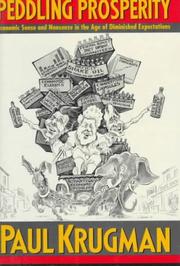
Peddling prosperity
The past twenty years have been an era of economic disappointment in the United States. They have also been a time of intense economic debate, as rival ideologies contend for policy influence. Above all, they have been the age of the policy entrepreneur - the …

The Return of Depression Economics
Our newest Nobel Prize-winning economist shows how today's crisis parallels the events that caused the Great Depression and explains what it will take to avoid catastrophe. In his 1999 book, Nobel Prize-winning economist Krugman surveyed the economic crises that had swept across Asia and Latin …

The age of diminished expectations
An insider's guide to the economic debates that will dominate the 1990s. Addresses all of the major problems facing the U.S. economy, and presents the evidence and arguments that are shaping U.S. economic policy.

The accidental theorist
This new book weaves together recent articles and addresses, some of them never before published, into a short, compelling narrative on the major issues of the late 1990s: unemployment, globalization, economic growth, financial speculation, and more. Some of the pieces start with current issues, like …

End This Depression Now!
A call-to-arms from Nobel Prize?winning economist and best-selling author Paul Krugman. The Great Recession is more than four years old, and counting. Yet, as Paul Krugman points out in this powerful volley, "Nations rich in resources, talent, and knowledge, all the ingredients for prosperity and …


The Great Unraveling
"This national bestseller chronicles the dangers of an administration that has raised dishonesty to dizzying heights. Economist Paul Krugman exposes the facts that speak for themselves. From identifying the flaws in George W. Bush's economic plans to telling the story behind California's energy crisis, to …

ECONOMICS
Written to make 'sure the student understands how economic models apply to the real world' as well as 'the models themselves.' Draws heavily on American examples.


Market Structure and Foreign Trade
Market Structure and Foreign Trade presents a coherent theory of trade in the presence of market structures other than perfect competition. The theory it develops explains trade patterns, especially of industrial countries, and provides an integration between trade and the role of multinational enterprises. Relating …


International Trade
"International Economics: Theory and Policy provides engaging, balanced coverage of the key concepts and practical applications of the two main topic areas of the discipline. For both international trade and international finance, an intuitive introduction to theory is followed by detailed coverage of policy applications. …



Development, geography, and economic theory
Paul Krugman argues that the unwillingness of mainstream economists to think about what they could not formalize led them to ignore ideas that turn out, in retrospect, to have been very good ones. Krugman examines the course of economic geography and development theory to shed …


Pourquoi Les Crises Reviennent Toujours
The Return of Depression Economics and the Crisis of 2008 is a non-fiction book by American economist and Nobel Prize winner Paul Krugman, written in response to growing socio-political discourse on the return of economic conditions similar to The Great Depression. The book was first …


Currencies and crises
This book brings together Paul Krugman's work on international monetary econmics from the late 1970s to the present, in an effort to make sense of a turbulent period that, in Krugman's words, "involved one surprise after another, most of them unpleasant." The eleven essays cover …

Currency Crises
There is no universally accepted definition of a currency crisis, but most would agree that they all involve one key element: investors fleeing a currency en masse out of fear that it might be devalued, in turn fueling the very devaluation they anticipated. Although such …


Exchange rate targets and currency bands
"Contains most of the papers presented at the conference on exchange rate targets and currency bands organized jointly by the Centre for Economic Policy Research and the National Bureau of Economic Research and held at the University of Warwick on 9-11 July, 1990"--Preface.

Fuzzy Math
"This book puts Paul Krugman's analysis, and powers of explanation firmly at the center of the debate about what to do with more than $5 trillion." "The United States will soon decide how to spend what is forecast as a $5.6 trillion surplus. President George …


Loose-leaf Version for Microeconomics


The self-organizing economy
In the last few years the concept of self-organizing systems - of complex systems in which randomness and chaos seem spontaneously to evolve into unexpected order - has linked together researchers in many fields, from artificial intelligence to chemistry, from evolution to geology. Now leading …


