James Donald Tracy is an American historian. With Heiko A. Oberman, he was co-founder of the Journal of Early Modern History, and editor from 1999 through 2010. He has served as president of the Sixteenth Century Society and Conference, the Society for Reformation Research, and the American Catholic Historical Association. At the University of Minnesota, he was associate dean of the College of Liberal Arts, chaired the Department of History, and held the Union Pacific Chair in Early Modern History from 2001 to 2004. Upon his retirement, Tracy was granted emeritus status.
From Wikipedia · CC BY-SA 4.0
13 books in our catalogue.
2011
261 pages
History
"The story of some of the most important and little-known activists of the 1960s, in a deeply sourced narrative history"--Page 4 of cover.
1991
512 pages
Business & EconomicsHistory
2008
343 pages
HistoryPolitics & Society
"In 1572, towns in the province of Holland, led by William of Orange, rebelled against the government of the Habsburg Netherlands. The story of the Dutch Revolt is usually told in terms of fractious provinces that frustrated Orange's efforts to formulate a coherent programme. In …
2002
360 pages
Biography & MemoirHistory
"Emperor Charles V (1500-1558) asserted his princely authority by deciding at times to lead his own armies to war, despite the misgivings of advisers. But because Europe's wars were fought with money borrowed against future revenues, even an emperor had to share power with his …
2001
96 pages
Politics & Society
1999
390 pages
Philosophy & Religion
"Europe's Reformations establishes a new standard for historians of the early modern era. In recent decades, Reformation scholars have dismantled the idea that the Middle Ages came to an abrupt end in 1517, with Martin Luther's Ninety-five Theses. Prominent historian James D. Tracy is the …
1986
108 pages
Politics & Society
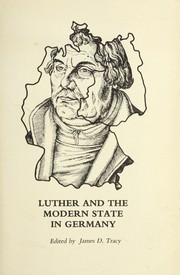
Very interesting collection of essays discussing whether Luther's views on religion and society inevitably led to the Third Reich.
1990
442 pages
History
European dominance of the shipping lanes in the early modern period was a prelude to the great age of European imperial power in the nineteenth and early twentieth centuries. Yet in the present age we can see that the pre-imperial age was in fact more …