Frederick Cooper is an American historian who specializes in colonialization, decolonialization, and African history. He is Professor Emeritus of History at New York University.
From Wikipedia · CC BY-SA 4.0
12 books in our catalogue.
2010
528 pages
HistoryPolitics & Society
This book "departs from conventional European and nation-centered perspectives to take a remarkable look at how empires relied on diversity to shape the global order. Beginning with ancient Rome and China and continuing across Asia, Europe, the Americas, and Africa," the authors "examine empires' conquests, …
2002
244 pages
HistoryPolitics & Society
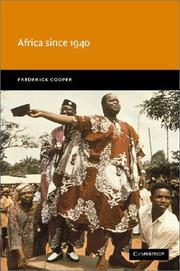
"Frederick Cooper's latest book on the history of decolonization and independence in Africa initiates a new textbook series: New Approaches to African History. His book will help readers understand the historical processes which have shaped Africa's current position in the world. Covering the last half-century, …
2018
224 pages
"Offers an overview of citizenship's complex evolution, from ancient Rome to the present. Political leaders and thinkers still debate, as they did in Republican Rome, whether the presumed equivalence of citizens is compatible with cultural diversity and economic inequality. The author presents citizenship as 'claim-making'--the …
2005
327 pages
Politics & Society
In this closely integrated collection of essays on colonialism in world history, Frederick Cooper raises crucial questions about concepts relevant to a wide range of issues in the social sciences and humanities, including identity, globalization, and modernity. Rather than portray the past two centuries as …
2001
432 pages
"Societies after Slavery is the definitive resource for scholars and students engaged in research on postemancipation societies in the Americas and Africa. Providing thousands of entries and scholarly annotations, the bibliography covers a span of emancipations from the British West Indies in the 1830s to …
2014
512 pages
HistoryPolitics & Society
As the French public debates its present diversity and its colonial past, few remember that between 1946 and 1960 the inhabitants of French colonies possessed the rights of French citizens. Moreover, they did not have to conform to the French civil code that regulated marriage …
2006
352 pages
HistoryPolitics & Society
>In the shadow of America’s recent military involvement in Iraq and Afghanistan, distinguished historians of empires and noted international relations specialists consider the dirty word “empire” in the face of contemporary political reality. Is “empire” a useful way to talk about America’s economic, cultural, political, …
2005
499 pages
Business & Economics
1997
463 pages
History
Starting with the premise that Europe was made by its imperial projects as much as colonial encounters were shaped by events and conflicts in Europe, this volume investigates metropolitan-colonial relationships. It shows how "civilizing missions" often provided new sites for a bourgeois order.